




The Myth: Crunch Equals Health
It’s a common assumption in the food world: a crunchy texture signifies something is fresh, natural, and good for you. We link the crispness of an apple or the snap of a fresh vegetable to health. This association often extends to the breakfast aisle,
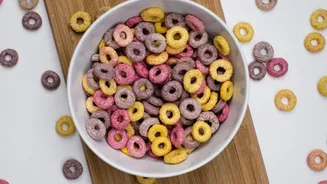
where we subconsciously believe that the crunchier the cereal, the more wholesome and fibre-packed it must be. This belief is reinforced by marketing that often showcases golden, crispy flakes and clusters as the picture of a healthy start to the day. For many, a cereal that gets soggy too quickly is a sign of being overly processed or less nutritious. But this connection between a cereal’s sound and its nutritional profile is a well-ingrained myth that deserves a closer look.
The Reality: What Really Makes Cereal Crunchy?
The crunch in most modern breakfast cereals is a feat of food engineering, not necessarily a sign of high-fibre ingredients. Processes like extrusion cooking use high heat and pressure to shape and puff up grains. Afterwards, baking or toasting dries them out to create a rigid, porous structure. Crucially, sugar plays a huge role. Syrups and sugar coatings caramelise during cooking, forming a hard, glassy shell that not only adds sweetness but is excellent at resisting milk and preserving that crunch. In fact, many cereals that are famously crunchy, like those made from puffed rice or corn, are often made from refined grains that have had their fibrous bran and germ stripped away, leaving mostly starch. So, the crunch you love is more often a product of processing and sugar content than it is an indicator of natural, fibre-rich whole grains.
Fibre: The Unsung Hero of Breakfast
Dietary fibre is the real nutritional powerhouse you should be looking for in a breakfast cereal. Health authorities recommend adults aim for about 25 to 38 grams of fibre per day, though most people get only about half that amount. Fibre is crucial for maintaining digestive health, and it also plays a key role in making you feel full and satisfied, which helps with weight management. Furthermore, a high-fibre diet is associated with a lower risk of serious health issues like heart disease, stroke, and type 2 diabetes. True fibre in cereals comes from whole grains—think whole wheat, oats, and bran—where the entire grain kernel is used. These ingredients provide both insoluble fibre for digestive regularity and soluble fibre, which can help manage cholesterol levels.
How to Be a Savvy Cereal Shopper
Instead of listening for the crunch, your best tool is your ability to read the box. First, check the ingredients list. Look for words like "whole grain," "whole wheat," or "bran" to be the very first ingredient. Ingredients are listed by weight, so if sugar or a refined grain like corn flour is listed first, it's the main component. Next, turn to the Nutrition Facts panel and find the "Dietary Fibre" line. A cereal with at least 3 grams of fibre per serving is considered a good source, while 5 grams or more is considered high in fibre. Comparing products using the "per 100g" column gives you a more accurate comparison than relying on serving sizes, which can vary wildly between brands. A product with a daily value (%DV) of 20% or more for fibre is considered an excellent source.