




The Unsung Hero of Core Work
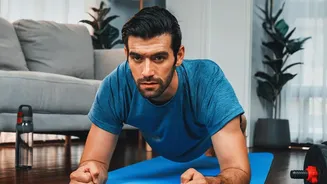
When people think of core training, they often picture endless crunches targeting the “six-pack” muscles (rectus abdominis). But true core strength is about creating a stable, resilient trunk that supports all movement. The side plank is a champion of this
philosophy. It's an isometric hold, meaning your muscles are under tension without moving, that builds incredible endurance and stability along the entire side of your body. Unlike exercises that only isolate one muscle, the side plank forces multiple muscle groups to work together as a team, which is exactly how your body functions in real life, whether you're carrying groceries or playing a sport.
More Than Just Obliques
While side planks are famous for targeting the internal and external obliques—the muscles along the sides of your waist responsible for twisting and resisting side-bending—their benefits run much deeper. To hold the position correctly, you must also engage your gluteus medius, a key muscle on the outside of your hip that stabilizes your pelvis. Your shoulder stabilizers, including the deltoids and rotator cuff, work hard to keep your upper body secure. Even the deep spinal muscle, the quadratus lumborum, gets a workout, which is crucial for protecting your lower back from injury.
How to Master the Form
Proper form is non-negotiable for reaping the benefits of a side plank. Start by lying on your side on a mat. Place your forearm on the floor with your elbow stacked directly underneath your shoulder to create a stable base. Extend your legs and stack your feet one on top of the other. Before lifting, brace your core and squeeze your glutes. Then, press through your forearm and the bottom edge of your foot to lift your hips off the ground until your body forms a straight, rigid line from your head to your heels. Keep your gaze forward, your top shoulder stacked directly above the bottom one, and breathe steadily.
Common Mistakes to Avoid
The most common mistake is letting the hips sag toward the floor, which defeats the purpose of the exercise and can strain your lower back. To fix this, actively think about lifting your bottom hip up toward the ceiling. Another frequent error is positioning the supporting elbow too far from the body instead of directly under the shoulder, placing unnecessary stress on the shoulder joint. Finally, avoid rolling your top shoulder forward or holding your breath. Maintaining stacked shoulders and consistent breathing ensures your core is doing the work.
Why Quality Trumps Complexity
The fitness world is full of complex, eye-catching exercise variations. While progressions like side plank hip dips or leg lifts have their place, they are only effective once you have mastered the foundational hold. A 30-second side plank with perfect alignment is infinitely more beneficial than a sloppy, 1-minute attempt at a more advanced version where your hips are dropping and your shoulder is unstable. The goal of the side plank is to build stability and endurance; compromising form for the sake of a “harder” variation undermines this goal and increases injury risk. True strength comes from perfecting the basics, not just attempting the advanced.