




A Voice from the Void
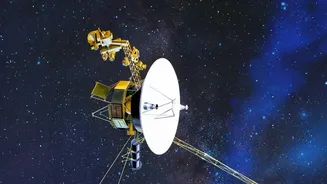
Launched in 1977, Voyager 1 is humanity's most distant creation. For nearly five decades, it has been our silent messenger to the cosmos, exploring Jupiter and Saturn before crossing into interstellar space in 2012—the first human-made object to do so.
It carries the famed Golden Record, a message in a bottle for any intelligence that might find it. But its primary mission has been to send back data about the environment beyond our solar system’s protective bubble. Powered by the heat of decaying plutonium, its 1970s-era computers have operated flawlessly in the harshness of deep space, a testament to the engineers who built it. That is, until late 2023, when its steady stream of data suddenly turned into gibberish.
The Garbled Signal
In November 2023, the unthinkable happened: Voyager 1 stopped making sense. While the spacecraft could still receive commands and send a carrier signal, the data it transmitted back to Earth was an unreadable, repeating pattern. After months of painstaking detective work, engineers at NASA's Jet Propulsion Laboratory (JPL) pinpointed the source of the problem. The issue was traced to the Flight Data Subsystem (FDS), one of three onboard computers responsible for packaging science and engineering data for transmission. Specifically, a single memory chip within the FDS had failed. This one faulty chip, holding just 3% of the FDS memory, had corrupted the entire data stream, effectively blinding the mission.
A Daring Digital Bypass
With the probe billions of kilometres away, a physical repair was impossible. The only solution was a digital one, and it was incredibly audacious. The JPL team couldn't fix the broken chip, so they decided to work around it. Their plan was to move the affected software code to other locations in the FDS memory. However, there was no single empty block of memory large enough to hold all the code. So, engineers had to meticulously divide the code into smaller sections and slot them into different available spaces. This digital surgery required them to update all related parts of the software so the scattered pieces would still work together as a cohesive whole. It was the equivalent of taking a critical paragraph from a book, tearing it into sentences, and pasting those sentences into the margins of other pages while ensuring the story still reads perfectly.
High-Stakes, Long-Distance Repair
The process was fraught with risk. A single command sent to Voyager 1 takes approximately 22.5 hours to travel at the speed of light to reach the probe. The team then had to wait another 22.5 hours for a response, meaning every single step of the troubleshooting process involved a 45-hour wait. One wrong command could have permanently silenced the historic spacecraft. The engineers began by sending the updated code for the engineering data on April 18, 2024. They held their breath for nearly two days. On April 20, the signal came back: for the first time in five months, Voyager 1 was sending back readable data about its own health and status. Over the next several weeks, they sent further commands to relocate and reactivate the software components responsible for transmitting science data. By mid-June, all four of Voyager 1's active science instruments were back online, returning valuable information from interstellar space.