






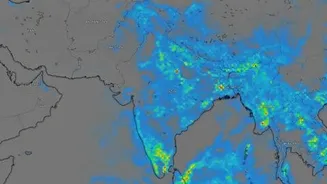

A Sudden, Fierce Downpour
In the first days of August 2026, several parts of central and northern Kerala were battered by an intense and highly localized rainfall event. Districts like Pathanamthitta, Idukki, Kozhikode, and Kottayam witnessed torrents of rain that led to devastating
flash floods and landslides, claiming several lives and displacing thousands. For instance, a rain gauge in Vadasserikkara, Pathanamthitta, recorded an astonishing 361 mm of rain in a 24-hour period. The sheer speed and volume of the water caught many communities off guard, with rivers like the Pamba and Manimala overflowing and inundating towns. The destruction was swift and severe, leading to a grim, familiar question in the aftermath: could this have been predicted more accurately?
The 'Cloudburst-Like' Conundrum
Many have described the event as a “cloudburst,” a term that evokes a terrifying image of the sky suddenly breaking open. Officially, the India Meteorological Department (IMD) defines a cloudburst as rainfall of 100 mm per hour over a small area of about 20-30 square kilometers. While the IMD has not officially confirmed these recent events as true cloudbursts, the term “cloudburst-like” has been widely used to describe the nature of the downpour: extremely heavy rain in a very short period over a concentrated area. These events are notoriously difficult to forecast because they are caused by small, fast-developing convective clouds that can form and unleash their contents rapidly, especially in mountainous terrain like Kerala's Western Ghats. The orographic lift provided by the mountains can cause moisture-laden monsoon winds to rise and condense quickly, creating the conditions for such intense spells.
A Mismatch in Alerts?
The core of the current controversy lies in the perceived gap between the IMD's warnings and the reality on the ground. Critics point out that while the IMD had issued Orange Alerts for many districts—indicating a forecast of heavy to very heavy rain—it failed to issue a timely Red Alert in the specific pockets that received the most extreme downpours. A Red Alert, which signifies rainfall likely to exceed 204 mm in 24 hours, was only officially announced for some districts after the worst of the rain had already caused significant damage. This delay, critics argue, meant that local authorities and residents were not prepared for the catastrophic intensity of the event. Kerala's Revenue Minister placed the responsibility on the IMD, stating that the state government can only disseminate the alerts it receives.
The Science of an Imperfect Forecast
The IMD has defended its actions, stating that it had placed all districts under alerts two days in advance based on forecasts of widespread rainfall. Forecasting experts explain that predicting the exact location and intensity of hyper-local events like cloudbursts is a global challenge. While current models are good at predicting rainfall over a wider region, pinpointing which small valley or town will get a sudden deluge is beyond the capacity of most existing technologies. Radars can provide a lead time of maybe three hours for such events, but even that is a challenge in the complex terrain of the Ghats. Furthermore, a recent study noted that rainfall in Kerala is becoming increasingly uneven and concentrated, making these extreme events more frequent and harder to predict with traditional methods.
Beyond the Alert: A Need for New Strategies
The events in Kerala highlight a critical new reality of the climate change era. As the atmosphere and oceans warm, they can hold and release more moisture, making extreme rainfall events more common. Researchers are now calling for a fundamental shift in disaster management strategy. The focus is moving from relying solely on centralized forecasts to building local-level resilience. This includes creating participatory, localized disaster management frameworks and using impact-based forecasting, which communicates not just the amount of rain expected but also its likely impact on specific areas. Experts argue that as these 'mesoscale mini cloudbursts' become a new norm for Kerala, disaster response must evolve from a reactive to a proactive model, where communities in vulnerable areas are prepared for the worst even when a Red Alert hasn't been issued.