




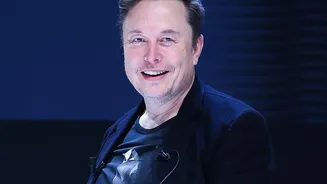

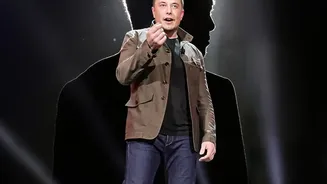
While busy revolutionizing electric cars, sending rockets to space, and redesigning the digital public square, Elon Musk has taken a firm stand on a new frontier: punctuation. His recent target? The long dash—or em dash—and its place in modern text.
The Punctuation Proclamation
In
a series of public comments on his platform, X, Elon Musk made his grammatical grievance known. He argued that the rules of English should be updated to include spaces around em dashes (—), suggesting they too closely resemble a hyphenated word. He didn't stop there, adding that the em dash itself is an 'unpleasantly long a line' and that the shorter en dash (–) is a 'better length'. This declaration wasn't in response to a major style guide or a linguistic debate, but rather a critique of another user's post. For a figure whose platform is a firehose of casual, often grammar-defying communication, the sudden, specific focus on a single punctuation mark struck many as a peculiar priority.
A Dash of Grammar
For those who don't spend their days debating style guides, the world of dashes can be a bit murky. The hyphen (-) is the shortest, used to join words like 'long-term'. The en dash (–), roughly the width of the letter 'N', is typically used to indicate a range, like 'pages 10–20'. Then there's the em dash (—), the longest of the three and the subject of Musk's critique. Named because it's about the width of the letter 'M', the em dash is a versatile and powerful tool. It's used to set off extra information, create a dramatic pause, or signal an abrupt change in thought—much like a comma or parenthesis, but with more stylistic punch. Its purpose is to create a strong, visible break in a sentence, which is precisely why it's longer than a hyphen.
The Irony of the Ideal
Musk’s focus on this tiny detail is ironic on multiple levels. Firstly, the platform he owns, X, is hardly a bastion of grammatical purity. It’s a place where character limits once forced extreme brevity and where communication is defined by speed, slang, and typos. To single out the em dash as a problem seems to ignore the forest for one very specific, and formally correct, tree. Secondly, Musk’s own communication style is famously direct and simple, often praised for its sixth-grade readability level, which helps him connect with a broad audience. This penchant for simplicity might explain his distaste for what he sees as a fussy, overly long punctuation mark. He seems to be applying an engineering mindset to language: find the most efficient tool and discard the rest.
More Than Just a Dash
Ultimately, this isn't really about grammar. It's about a particular worldview—one that sees established systems, whether in manufacturing, space travel, or even language, as things to be optimized. Musk has a history of questioning accepted norms, from academic credentials to traditional education models, arguing that learning should be about solving problems, not memorizing tools. His critique of the em dash fits this pattern perfectly. He isn't arguing from the perspective of a grammarian, but from the perspective of a user and an engineer who finds a particular component inefficient or aesthetically unpleasing. It’s a small-scale reflection of his larger operational philosophy: if a rule or tool doesn't serve a clear, streamlined purpose in his eyes, it's a candidate for removal or reinvention.