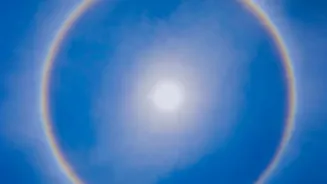








A Celestial Mirage
NASA's Astronomy Picture of the Day for August 2 showcased a vibrant, flame-like splash of colour in the sky, an event often misidentified as a fire rainbow. The image highlights a breathtaking optical phenomenon that, despite its fiery appearance, is a cold,
high-altitude illusion. The term 'fire rainbow' itself is a misnomer, apparently coined around 2006, likely due to the way the colours can seem to lick the sky like flames when seen through patchy clouds. The official term for this beautiful display is a circumhorizontal arc. Unlike an actual rainbow, which forms an arc opposite the sun, a circumhorizontal arc is a flat, broad band of colour that runs parallel to the horizon.
The Science of Ice, Not Rain
So, if it’s not a rainbow, what creates it? The secret lies not in raindrops, but in tiny ice crystals. This phenomenon occurs in high-level cirrus clouds, which are thin, wispy clouds floating at altitudes where the temperature is low enough for water to freeze. These clouds are composed of millions of tiny, plate-shaped, hexagonal ice crystals. For a circumhorizontal arc to form, these flat, six-sided crystals must be aligned horizontally, almost like tiny plates floating in the atmosphere. Sunlight enters through a vertical side face of these crystals and exits through the bottom horizontal face. This 90-degree refraction of light acts like a prism, splitting the sunlight into its constituent colours and projecting a vibrant spectrum across the sky.
A Question of Angles and Location
Seeing a circumhorizontal arc is a matter of being in the right place at the right time. The conditions for one to appear are quite precise, making them a relatively rare sight. The primary requirement is the sun's position in the sky; it must be at an elevation of 58 degrees or higher above the horizon. This is why these arcs are most commonly seen during the summer months in mid-latitude regions, like much of the United States. For locations north of 55° N latitude or south of 55° S latitude, the sun never gets high enough in the sky for a circumhorizontal arc to form, making it a phenomenon that many people around the world will never get to witness.
How It Differs from a Rainbow
While both phenomena paint the sky with colour, the differences between a circumhorizontal arc and a common rainbow are significant. A rainbow is formed by sunlight refracting and reflecting through liquid water droplets, typically after a rain shower. It always appears in the part of the sky opposite the sun. A circumhorizontal arc, on the other hand, is formed by light refracting through solid ice crystals and always appears below the sun. The colours in a circumhorizontal arc are also often purer and more distinctly separated than in a rainbow, appearing as a neat band with red on top and violet at the bottom. Furthermore, while rainbows form a distinct arch, a circumhorizontal arc is, as its name suggests, parallel to the horizon.
Don't Be Fooled by Other Sky Illusions
The 'fire rainbow' is sometimes confused with another beautiful phenomenon called cloud iridescence. Iridescent clouds also show pastel, rainbow-like colours, but their origin is different. Iridescence is caused by the diffraction of light by either water droplets or ice crystals, often appearing as more random, shimmering patches of colour, similar to a patch of oil on water. The key difference is the order and position. A circumhorizontal arc has the organized, spectral colours of a rainbow and is always found far below the sun, while iridescence has more randomly distributed colours and can appear in various parts of the sky, often close to the sun or moon.