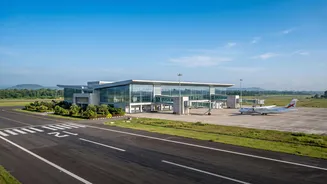









The dream of connecting West Bengal's smaller towns with affordable flights is closer than ever, yet remains tantalizingly out of reach. While new agreements promise a brighter future, the expansion of the UDAN scheme hinges on critical approvals.
A Fresh Push for Regional Connectivity
In early
October 2026, West Bengal officially partnered with the Union Civil Aviation Ministry to accelerate the Ude Desh ka Aam Nagrik (UDAN) scheme, a central government initiative to make air travel affordable and widespread. The agreement includes plans to develop four new airports at Charra in Purulia, Kalaikunda in Paschim Medinipur, Balurghat in Dakshin Dinajpur, and Hasimara in Alipurduar. With a proposed investment of ₹29,000 crore over the next decade, the goal is to double the number of operational airports in the state within two years, boosting tourism, trade, and economic growth. However, this ambitious timeline is entirely dependent on overcoming the hurdles that have historically plagued aviation expansion in the region.
The Challenge of Paperwork and Pavement
The core of the issue lies in the complex process of making an airport flight-ready. Under the new agreement, the state government is responsible for providing land and basic infrastructure like power and water, while the Airports Authority of India (AAI) will manage airport development and flight operations. This process is far from simple. Each new or revived airport requires a series of clearances, including final aerodrome licensing from the Director General of Civil Aviation (DGCA). This license is only granted after the airport meets stringent safety, infrastructure, and operational standards. Delays in land acquisition, construction of runways and terminal buildings, or installation of necessary navigation and safety equipment can halt the entire process.
Case Studies in Delay: Malda and Cooch Behar
The long-standing issues at Malda and Cooch Behar airports serve as cautionary tales. The Malda airport, non-operational for commercial flights since the 1980s, has seen renewed efforts for revival. Recent joint surveys have focused on acquiring nearly 60 acres of land to extend the runway, a critical requirement for operating modern aircraft. However, challenges like existing high-rise buildings and power lines near the airstrip remain significant obstacles. Similarly, the Cooch Behar airport has had a history of inconsistent service. A flight service to Kolkata, launched in 2023, was reportedly set to be discontinued in early 2026 after the airline operator decided not to renew its contract, highlighting how operational viability is as crucial as infrastructure readiness. These airports demonstrate that building infrastructure is only half the battle; ensuring sustainable flight operations is the other.
From Blueprint to Boarding Pass
For the four newly announced airports, the path from blueprint to reality involves several steps. Two of the locations, Kalaikunda and Hasimara, are existing air force bases that will be developed into civil enclaves, which can streamline development as they already possess long runways capable of handling large aircraft. Balurghat airport, which is owned by the AAI, requires expansion. The project at Charra in Purulia involves reviving a World War II-era airstrip. While officials have set a two-year target, this timeline is contingent on the swift completion of all groundwork and securing the necessary regulatory green lights from agencies like the DGCA. The success of these projects will depend on coordinated execution between the state and central governments, avoiding the land acquisition and bureaucratic delays that have previously stalled progress.