





A New Eye on the Cosmos
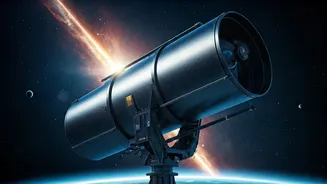
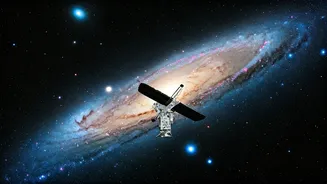
Scheduled for launch in August 2026, the Nancy Grace Roman Space Telescope is NASA's next great observatory. Named after the agency's first Chief of Astronomy, Nancy Grace Roman, who is often called the 'mother of Hubble', this mission is designed to tackle
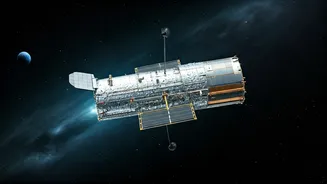
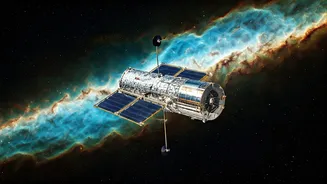
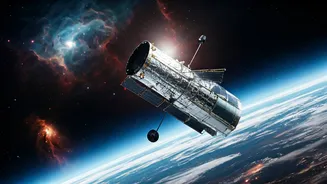
some of the biggest questions in cosmology today. While it shares a mirror of the same size as the Hubble Space Telescope—2.4 meters in diameter—its capabilities are vastly different. The telescope is currently at Kennedy Space Center, undergoing final preparations for its journey to a destination about 1.5 million kilometers from Earth, a point in space known as L2. This mission, formerly known as WFIRST, represents a new strategy in our quest to understand the universe.
The Power of a Wide-Angle Lens
Roman's superpower is its incredible field of view. Its Wide Field Instrument (WFI) will be able to capture an area of the sky at least 100 times larger than Hubble can in a single snapshot, all while maintaining a similar crystal-clear resolution. Think of it as the difference between taking a detailed close-up of a single flower and capturing the entire meadow in the same sharp focus. This ability to rapidly survey huge swathes of the sky will allow Roman to create unprecedented cosmic maps. In just under a year and a half, its main survey is planned to cover about 12 percent of the sky, imaging hundreds of millions of galaxies. This efficiency means Roman can accomplish in days what would take Hubble years, generating enormous datasets for astronomers to explore for decades.
Hunting the Universe's Dark Side
About 95% of the universe is made of things we can't see: dark matter and dark energy. Dark energy, which makes up about 68% of the cosmos, is the mysterious force causing the universe's expansion to accelerate. Roman's primary mission is to help solve the mystery of dark energy. It will do this in several ways, including a technique called weak gravitational lensing. By observing how the light from distant galaxies is subtly distorted by the gravity of intervening dark matter, scientists can map its distribution and study how dark energy has influenced the cosmos over time. This massive survey of galaxies and their distribution will provide the most detailed 3D maps of the universe ever created, offering crucial clues about its shadowy underpinnings.
A New Way to Find Worlds
Beyond cosmology, Roman is poised to revolutionize the hunt for exoplanets. While missions like Kepler found thousands of planets using the 'transit' method (watching for a star's light to dim), Roman will primarily use a different technique called gravitational microlensing. This phenomenon occurs when a star or planet passes in front of a more distant star, and its gravity acts like a lens, briefly magnifying the background star's light. Because this method is sensitive to a planet's mass, it can detect worlds much smaller and farther from their star than other methods. Roman is expected to discover thousands of new exoplanets this way, from worlds a fraction of Earth's mass to rogue planets that drift through the galaxy without a host star.
A Cosmic Partner, Not a Rival
With its wide-field surveys, Roman is not a replacement for telescopes like the James Webb Space Telescope (JWST), but a powerful partner. Roman is the ultimate scout; it will identify countless fascinating targets across its vast images. JWST, with its incredibly powerful but narrow view, can then perform detailed follow-up studies on the most interesting objects Roman finds. For example, Roman's microlensing survey will provide a statistical census of planetary systems, while its advanced coronagraph—a technology demonstrator for blocking starlight—will help pave the way for future missions to directly image Earth-like planets. Together, these great observatories will give us our most complete picture of the universe yet.