







An Era of Missing Sunspots
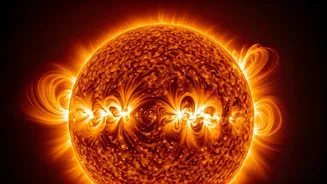
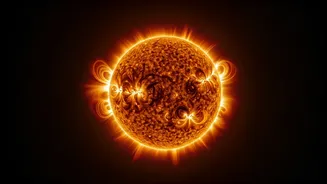
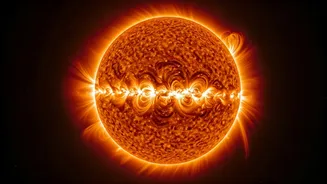
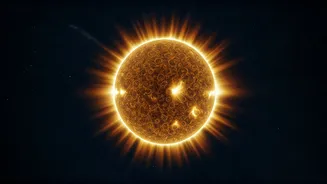
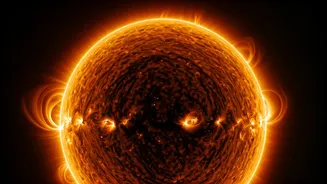
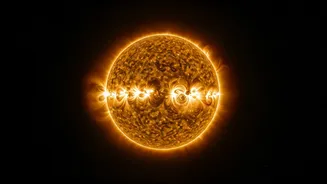
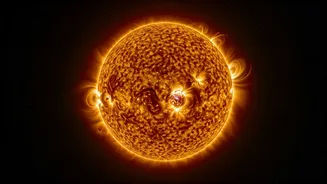
Between roughly 1645 and 1715, something strange happened to the Sun: its face went nearly blank. This 70-year period, now known as the Maunder Minimum, was marked by a dramatic reduction in sunspots. Sunspots, which are dark patches on the solar surface,
are indicators of intense magnetic activity. They normally follow a predictable 11-year cycle of waxing and waning. During the Maunder Minimum, however, astronomers of the era, such as Giovanni Cassini and John Flamsteed, sometimes went years without observing a single spot. In one 28-year stretch, fewer than 50 were recorded, compared to the tens of thousands that would be typical for a similar modern period. This wasn't due to a lack of observation; diligent astronomers were watching, but the Sun's regular heartbeat seemed to have faded to a whisper.
The 'Little Ice Age' Connection
The Maunder Minimum's timeline intriguingly overlaps with the middle of the 'Little Ice Age', a period when parts of the Northern Hemisphere experienced colder-than-average temperatures. Rivers like the Thames in London famously froze over, and glaciers in the Alps advanced on farmland. This has led to a long-standing scientific debate: did the Sun's quiet spell cause the cooling? The answer is complex. Scientists agree that the timing is suggestive, but correlation isn't causation. Most research now indicates that the Little Ice Age began before the Maunder Minimum and that its primary cause was likely increased volcanic activity, which spews sun-blocking aerosols into the atmosphere. However, the reduced solar output during the quiet spell likely contributed to the cooling, even if it wasn't the main driver. Understanding this nuanced relationship is vital for refining today's climate models.
A Key to Predicting Space Weather
The past is a laboratory for the future. By studying the Maunder Minimum, solar physicists hope to understand the mechanisms that can cause such a 'grand solar minimum' and predict if and when one might happen again. While a solar slowdown might sound pleasant, it has significant implications for our technologically dependent society. A grand minimum would affect the Sun's magnetic field, which in turn shields our solar system from high-energy cosmic rays. Increased cosmic rays can pose a radiation risk to astronauts and satellite electronics. Furthermore, understanding the extremes of solar behaviour is crucial for predicting space weather—the solar flares and coronal mass ejections that can disrupt power grids, GPS, and communication systems on Earth. The Maunder Minimum represents the most extreme 'quiet' our Sun has been in modern history, providing an essential data point for forecasting its future behaviour.
Searching for Life Beyond Earth
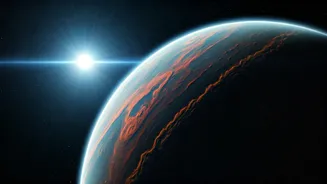
The relevance of the Sun's history extends far beyond our own solar system. As scientists search for habitable exoplanets orbiting distant stars, a key factor is the stability of the host star. A star's magnetic activity—or lack thereof—drives space weather in its system, which can strip away the atmospheres of orbiting planets, rendering them uninhabitable. Our own Sun's history, including its stable periods and its grand minima, serves as a crucial reference point. By understanding the full range of behaviours our star is capable of, astronomers can better evaluate the data coming from missions like the James Webb Space Telescope. They can identify which stars are most likely to provide a stable, life-friendly environment and which might be too volatile. In this way, studying our sun’s 17th-century quiet spell helps fine-tune the search for other Earths in the 21st century and beyond.