



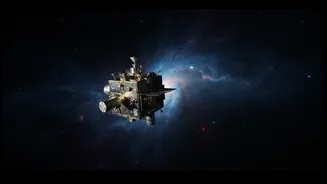


The Case of the Missing Asteroid
In the world of planetary defense, knowing where an object will be is everything. Scientists rely on complex calculations, factoring in the gravitational pull of the Sun and planets to plot the future course of near-Earth objects. But in August 2025,
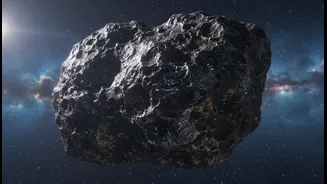
astronomers got a surprise. An asteroid named 1998 SH2, which was making a close (but safe) pass of Earth, was not where it was supposed to be. For an object whose orbit had been tracked for decades, this was a significant anomaly. It had drifted from its predicted path due to a force that wasn’t gravity. This celestial mystery prompted an investigation that would fundamentally change our understanding of this object and others like it.
A Wolf in Asteroid's Clothing
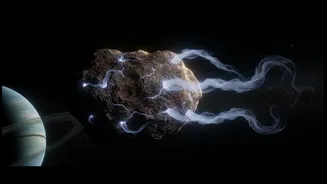
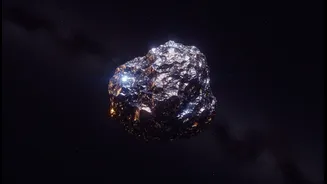
For years, 1998 SH2 was classified as a potentially hazardous asteroid. It was a nearly 400-metre-wide rock on a highly elliptical orbit, one of thousands of objects monitored by planetary defense agencies. But its unexplained orbital shift suggested it was more than just a lump of rock. Scientists suspected it might be a comet in disguise. Unlike asteroids, which are mostly rock and metal, comets are mixtures of ice, rock, and dust. When a comet gets close to the Sun, its ice turns directly into gas, a process called outgassing. This escaping gas acts like a tiny, natural rocket engine, pushing the comet and altering its trajectory in ways that gravity alone cannot explain. To test this theory, astronomers pointed some of the world's most powerful telescopes at 1998 SH2. The resulting images confirmed their suspicions: the 'asteroid' had a faint but distinct tail, the classic signature of a comet.
The Problem of 'Dark Comets'
The discovery revealed that 1998 SH2 is what some call a 'dark comet' or an 'active asteroid'. These are objects that spend most of their time looking like boring asteroids, with no visible tail or coma. However, they harbour hidden ice that releases small, often undetectable, jets of gas. This creates a major headache for planetary defense. The entire strategy for preventing an asteroid impact relies on precise, long-term trajectory predictions. If an object is set to hit Earth in 50 years, we can potentially send a mission to give it a tiny nudge now, ensuring it misses us by a wide margin later. But if that same object is a dark comet, its outgassing could randomly change its path, making our long-term forecasts unreliable. An object we thought would safely miss Earth could be nudged onto a collision course by its own hidden activity, or vice-versa.
Rethinking Planetary Defence
The case of 1998 SH2 doesn't mean we are suddenly in more danger. The object itself poses no threat for the foreseeable future. What it does mean is that our model of the solar system needs an update. Scientists now know they can't assume that an object without a visible tail is simply a passive piece of rock. They must consider the possibility that many objects currently classified as asteroids could be weakly active comets. This knowledge forces a re-evaluation of how we assess risk. It underscores the critical need for more powerful observatories, like NASA's upcoming NEO Surveyor mission, which is specifically designed to detect these faint and dark objects. By identifying which near-Earth objects have this hidden potential for unpredictable movement, we can monitor them more closely and build more robust defense strategies.