


Two Missions, One Shared Vision
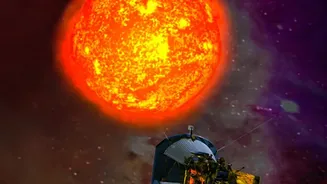
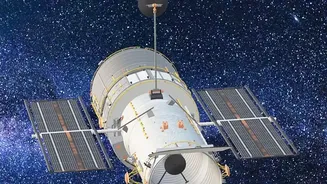
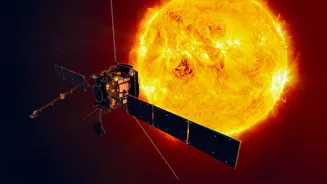
At the heart of this collaboration are two of the most advanced solar observatories ever launched. India's Aditya-L1, the nation's first dedicated solar mission, has been observing the Sun continuously since it reached its orbital home at Lagrange point
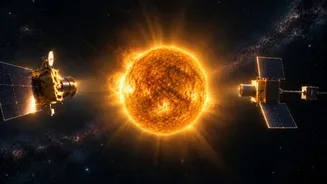
1 (L1) in January 2024. Its suite of seven instruments is designed to study the Sun's atmosphere, from the chromosphere to the outermost corona, providing crucial data on solar dynamics. Complementing it is the European Space Agency's (ESA) Proba-3, a revolutionary mission launched by an ISRO PSLV rocket in December 2024. Proba-3 consists of two satellites flying in precise formation, about 150 meters apart, to create an artificial solar eclipse. This unique setup allows its coronagraph, ASPIICS, to observe the Sun's faint inner corona with remarkable clarity, a region notoriously difficult to study.
A Partnership Forged in the Stars
While Aditya-L1 and Proba-3 are independent missions, their scientific goals are highly complementary. The recent collaboration, led by researchers at the Indian Institute of Astrophysics (IIA) in Bengaluru, marks the first time data from both missions have been jointly analysed to study the same solar events. By combining observations from Aditya-L1's Visible Emission Line Coronagraph (VELC) and Proba-3's ASPIICS instrument, scientists can now achieve a more complete picture of solar eruptions than either spacecraft could provide alone. VELC provides spectroscopic data, allowing scientists to measure the temperature and density of the coronal plasma, while ASPIICS captures high-resolution images of the event. This powerful combination creates a comprehensive, cross-checked view of an eruption's birth and early evolution.
Decoding Coronal Mass Ejections
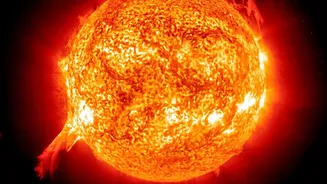
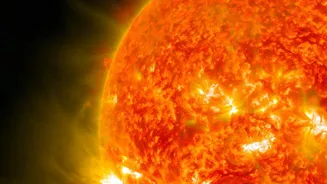
The focus of this joint study is Coronal Mass Ejections (CMEs), which are colossal eruptions of magnetised plasma from the Sun. When directed at Earth, these events can trigger geomagnetic storms that pose a significant threat to our technologically dependent society, capable of disrupting satellites, power grids, and communication systems. Understanding how a CME's energy is distributed between its kinetic (motion), thermal (heat), and magnetic components right after it erupts has been a major challenge for solar physicists. Previous instruments struggled to observe the faint details of CMEs very close to the bright solar disk. The combined power of Aditya-L1 and Proba-3 has finally allowed scientists to accurately measure the mass, density, and energy of CMEs in this critical inner corona region, providing vital information for space weather prediction models.
Why This Breakthrough Matters for India
This successful collaboration is a significant milestone for ISRO and the Indian scientific community. It showcases India's rising capabilities as a major space power, demonstrating that its missions can produce world-class data that complements efforts by other leading space agencies. The launch of an ESA mission like Proba-3 on an Indian PSLV rocket already highlighted the growing trust and synergy between the two space programmes. This joint scientific analysis takes that partnership to the next level. The findings not only advance our fundamental understanding of the Sun but also provide practical benefits. By improving our ability to predict space weather, this research helps protect India's growing fleet of satellites and vital terrestrial infrastructure from the potentially damaging effects of solar storms.