


Our Galactic Neighbor
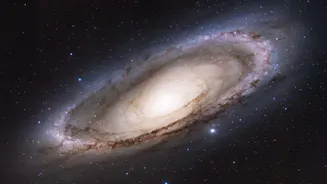
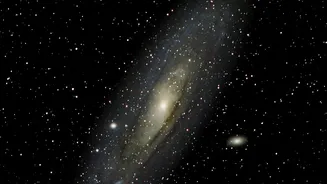
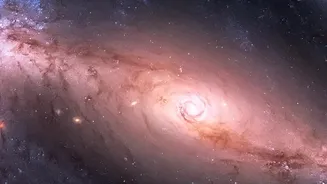
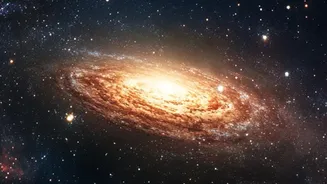
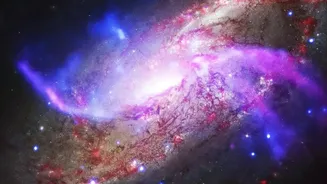
At a distance of 2.5 million light-years, the Andromeda galaxy, also known as M31, is practically in our backyard in cosmic terms. It's the closest major galaxy to our own Milky Way and is so large and bright it can be seen with the naked eye from dark
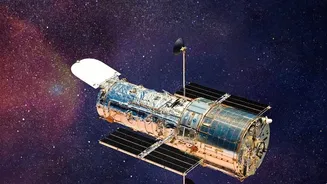
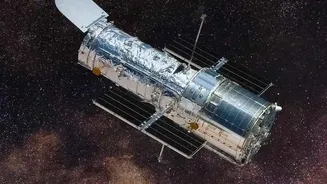
locations. This proximity makes it an invaluable laboratory for astronomers. By studying Andromeda in detail, scientists can learn about the processes that shape spiral galaxies like our own, effectively using it as a mirror to understand the past and future of the Milky Way. A new study published in The Astrophysical Journal did just that, leveraging the incredible power of NASA's Hubble Space Telescope to create a detailed 'fossil record' of Andromeda's history by mapping 200 million of its individual stars.
The Slowing Factory of Stars
Stars are born from vast, collapsing clouds of cool gas and dust. For billions of years, Andromeda was a bustling factory for new stars. Previous research indicated it went through a massive burst of star birth about 2 billion years ago, likely triggered by a merger with a smaller galaxy. But the new Hubble data reveals that since then, its productivity has been in a steady decline. The study shows that 500 million years ago, Andromeda was forming stars at a rate of about one solar mass per year. By 40 million years ago, that rate had been cut in half. Today, the output has plummeted to just one-fifth of a solar mass per year, indicating the galaxy is entering a much quieter phase of its life.
An Inside-Out Decline
The headline-making part of the discovery is that this slowdown isn't happening uniformly. By dividing the galaxy into thousands of sections, researchers found that the decline is most pronounced in specific areas. Much of Andromeda's most recent star formation has been happening in a prominent ring about 32,000 light-years from the galactic center. It's the fading of activity within this ring that is driving much of the overall decline. This creates an 'inside-out' pattern where the inner regions of the galaxy are becoming quiescent, or 'quenched', while some star birth continues in the outer reaches. This uneven shutdown provides astronomers with a fascinating snapshot of a galaxy in transition, as it slowly evolves from an active, star-making spiral into a more passive one.
A Case of Cosmic Exhaustion
So, what's causing Andromeda to wind down? It doesn't seem to be a case of running out of fuel. Scientists say the galaxy still has plenty of the raw gas and dust needed to make new stars. Instead, it appears to be a natural process of exhaustion following its more active youth. One lead author likened it to needing to take a breather after running a marathon. However, another culprit may be involved: Andromeda's small satellite galaxy, M32. Researchers noted a distinct drop in star formation in the area near M32, suggesting a close pass around 60 million years ago could have disrupted the gas clouds necessary for star birth. While not conclusive, scientists consider M32 a 'likely suspect' in accelerating the slowdown in that particular region.
A Glimpse of Our Future?
Studying the slow fade of Andromeda is more than just an academic exercise; it could be a preview of our own galaxy's distant future. The processes happening next door help scientists refine their models of how all spiral galaxies age and eventually stop forming stars. Understanding why Andromeda's stellar nurseries are going quiet provides crucial clues for predicting the long-term evolution of the Milky Way. This is especially relevant given that Andromeda and the Milky Way are on a collision course, set to merge into one giant galaxy in about 4.5 billion years. This new research gives us a clearer picture of the state our galactic neighbor will be in when that cosmic crash finally occurs, helping us to better understand the destiny of our own corner of the universe.