



The Daily Strain on Your Wrists
For those who spend hours at a computer, the wrists are in a constant state of low-level activity. Typing and using a mouse involve thousands of repetitive motions that can, over time, lead to discomfort, strain, and more serious conditions like Repetitive
Strain Injury (RSI) or carpal tunnel syndrome. These issues arise from the continuous stress on the muscles and tendons in the forearms and wrists. An improper desk setup, such as a keyboard that is too high or a mouse that requires overreaching, can force the wrists into unnatural angles, worsening the strain. Poor posture, like slouching, creates a chain reaction of misalignment from your shoulders down to your hands, further increasing tension. Overlooking these early signs of fatigue can lead to chronic pain and reduced mobility, making prevention a critical part of any desk-bound routine.
How Gentle Movement Helps
The human body isn't designed to stay still for eight hours a day. Gentle movements like wrist rotations act as a 'reset' button, counteracting the negative effects of static postures. Performing these circles helps improve blood flow to the hands and wrists, which is often restricted during long periods of inactivity. This increased circulation delivers vital nutrients and oxygen to the tissues while helping to flush out metabolic waste. Furthermore, the motion helps lubricate the many small joints within the wrist, maintaining their range of motion and preventing stiffness. Think of it as a mini-mobilisation session that keeps the complex machinery of your wrist functioning smoothly. This simple act is a powerful preventative measure that prepares the muscles and connective tissues for activity and reduces the overall risk of injury.
Performing Wrist Rotations: A Simple Guide
The beauty of this exercise is its simplicity. It can be done anywhere, anytime, without any equipment. To perform a basic wrist rotation, you can be sitting or standing. Extend your arms in front of you or rest your forearms on your desk. Make a gentle fist with each hand to start. Slowly and deliberately, rotate your wrists in a circular motion. Aim for the largest circle you can make comfortably, without forcing the movement or causing pain. Perform 5 to 10 rotations in a clockwise direction, then reverse and complete another 5 to 10 rotations counter-clockwise. The key is to isolate the movement to your wrists, avoiding any swinging of your arms or elbows. Keep the motion smooth and controlled, not jerky. If you feel any sharp pain, stop immediately.
Make it a Habit: When and How Often
Consistency is more important than intensity. The goal is to integrate these small movements into your daily workflow so they become second nature. A great strategy is to take 'microbreaks' throughout the day. Set a reminder to pause every hour, or use the '20-20-20' rule for eye strain as your cue: every 20 minutes, look at something 20 feet away for 20 seconds, and use that moment to do your wrist rotations. Attaching this new habit to an existing one, like getting up for water or after finishing a big task, can also be effective. Performing these exercises two to three times daily can significantly combat wrist stiffness and improve circulation. These brief, frequent breaks are often more effective at preventing strain than a single, longer stretching session at the end of the day.
Beyond Circles: Other Helpful Stretches
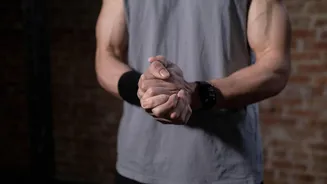
While wrist rotations are excellent, a well-rounded approach includes other stretches for the hands and forearms. The 'Prayer Stretch' is a classic: press your palms together in front of your chest and slowly lower them toward your waist until you feel a gentle stretch. To target the extensor muscles on top of your forearm, extend one arm with the palm down and gently use your other hand to bend your wrist downward. To stretch the flexors on the underside, extend your arm with the palm up and gently pull your fingers down toward the floor. Hold each stretch for 15 to 30 seconds without bouncing. Simply spreading your fingers wide and then making a fist a few times can also improve circulation and dexterity.