

A Famous Star in Our Cosmic Neighbourhood
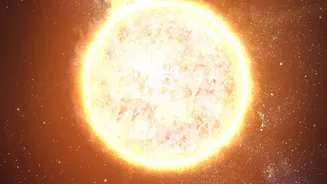
Beta Pictoris is not just any star; it's a star that astronomers have studied intensely for decades. It's incredibly young, at only about 23 million years old, compared to our Sun's 4.6 billion years. This youth is precisely what makes it so valuable.
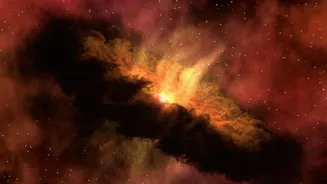
The star is surrounded by a huge, bright disc of dust and debris—the raw materials left over from its formation. This 'protoplanetary disk' is a messy, chaotic construction site where planets, asteroids, and comets are still taking shape. It gives us a rare opportunity to watch a planetary system in its infancy, offering clues about how our own solar system might have looked billions of years ago.
Meet the Giant Siblings: Beta Pictoris b and c
Before the latest discovery, Beta Pictoris was already known to host two colossal gas giants. The first, Beta Pictoris b, was one of the very first exoplanets to be directly photographed back in 2008. Its companion, Beta Pictoris c, was discovered later using the 'radial velocity' method, which detects the tiny wobble a planet's gravity induces in its parent star. Both of these worlds are behemoths, estimated to be around ten times the mass of Jupiter, the largest planet in our solar system. Their sheer size and presence within the dusty disk confirmed that massive planets can form and exist in such dynamic environments.
The New Arrival: A Smaller, Fainter World
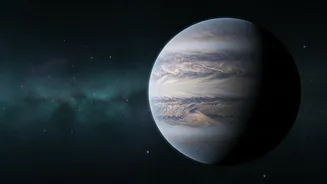
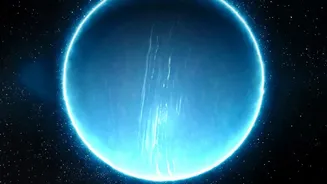
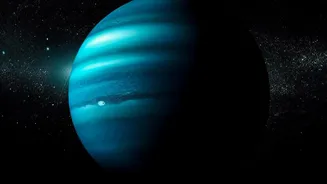
The newest member of the family, Beta Pictoris d, was a surprise discovery. It is also a gas giant, but significantly smaller than its siblings. With a mass estimated to be about 2.4 times that of Jupiter, it is by far the smallest of the three known planets in the system. This makes it one of the least massive exoplanets ever to be directly imaged from the ground. It is also about 100 times fainter than Beta Pictoris b, which made it incredibly difficult to spot against the bright glare of the star and its surrounding disk. In fact, after it was first identified with new instruments, astronomers realised the planet had been hiding in archival data for over a decade.
A New Way to Find Planets
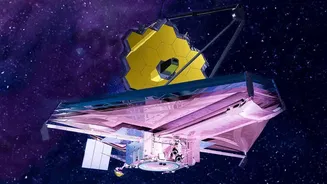
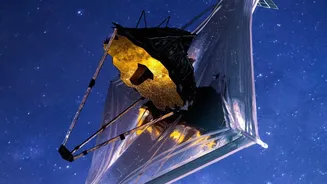
The discovery of Beta Pictoris d is not just exciting because it adds another planet to the system; it’s also significant because of how it was found. While older images helped confirm its existence, the planet was first truly identified by analysing the chemical signature of its atmosphere using NASA's James Webb Space Telescope. Instead of just looking for a point of light, scientists detected the molecular fingerprints of methane, carbon monoxide, and water vapor. This technique, known as moderate-resolution spectroscopy, represents a powerful new strategy for finding planets that might otherwise be completely hidden in the dusty, bright environments around young stars.
Why This Distant Family Matters
Studying the Beta Pictoris system helps us piece together the puzzle of planet formation. With three giant planets now confirmed, it becomes only the second system (along with HR 8799) where more than two planets have been directly imaged. This allows for a unique comparison of multiple planets that formed from the same material at the same time. The existence of a smaller giant like Beta Pictoris d, and its location within the system, provides crucial data for testing and refining our theories about how planetary systems are built. In a way, watching Beta Pictoris grow up is like looking at a family photo of our own solar system's childhood, helping us understand if our cosmic home is common or exceptionally rare in the universe.