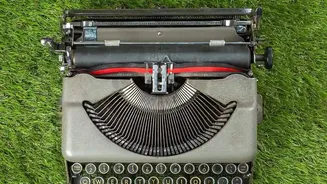








Take a look at the keyboard you're using. The first six letters spell out 'QWERTY'. It feels natural, but this layout is a ghost from the 19th century, a relic of a mechanical world that has no business being on your 21st-century device. So why is it
here?
A Solution to a Clunky Problem
The story begins not with computers, but with the first commercially successful typewriters in the 1870s. An American inventor named Christopher Latham Sholes, along with his partners, developed a machine to make writing faster and more legible than handwriting. However, their early prototypes, which had keys arranged alphabetically, had a critical flaw. The typewriters worked using a system of metal arms, or typebars, that would swing up to strike an inked ribbon against the paper. When a typist worked too quickly, the arms of frequently used, adjacent letters (like 'T' and 'H') would collide and jam, forcing the user to stop and untangle the mess. It was a frustrating mechanical bottleneck that defeated the very purpose of the machine.
The Birth of QWERTY
To solve the jamming issue, Sholes began a years-long process of trial and error to rearrange the keyboard. The goal was not, as a popular myth suggests, to slow typists down. Instead, the objective was to allow for faster typing by preventing these interruptions. The solution was to separate the most common letter pairings in the English language, placing them farther apart on the keyboard. This reduced the likelihood of their corresponding typebars clashing. The resulting layout, patented around 1873 and named for its first six keys, was a clever piece of mechanical engineering. It was a design born from physical limitations, not digital efficiency.
From Niche Invention to Global Standard
The invention's turning point came when Sholes and his financial backer, James Densmore, struck a manufacturing deal with E. Remington and Sons, a well-known arms manufacturer. In 1874, the first 'Sholes & Glidden Type-Writer' hit the market, featuring the QWERTY layout. Its success was cemented with the release of the Remington No. 2 in 1878, the first typewriter to include a shift key for both uppercase and lowercase letters. As Remington's typewriters gained market dominance, so did QWERTY. Competing manufacturers eventually adopted the layout to stay competitive, and typing schools began teaching it as the standard method. A business decision had effectively locked in a technological standard.
The Challengers That Never Stood a Chance
Over the decades, several alternative layouts have been proposed, each claiming to be more efficient than QWERTY. The most famous is the Dvorak Simplified Keyboard, patented in 1936. August Dvorak designed his layout to minimize finger movement and place the most frequently used letters on the home row, where fingers naturally rest. Proponents claim it can increase typing speed and reduce fatigue. However, despite its ergonomic advantages, Dvorak and other alternatives like Colemak never displaced the incumbent. By the time they appeared, the 'network effect' of QWERTY was too powerful. Millions had been trained on it, and the cost and inconvenience of retraining an entire workforce were simply too high for individuals and companies to bear.
Why We're Still 'Stuck' With It Today
The persistence of QWERTY is a classic example of what economists call 'path dependence'—where a standard remains in place simply because it got there first and is too embedded to change. The original mechanical reasons for its design are now completely obsolete. Modern laptops and smartphones have no physical typebars to jam. Yet, we continue to use QWERTY on our touchscreens and digital keyboards primarily out of familiarity. Introducing a new layout would mean confusing billions of users who have spent their lives building muscle memory around this 150-year-old arrangement. It survives not because it's the best, but because it's 'good enough' and universally understood.