





A 50-Year Cosmic Mystery
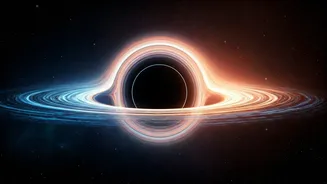
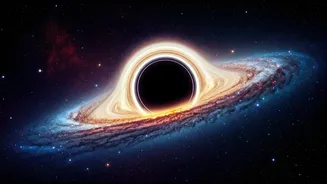
Imagine trying to understand a storm by only seeing the calm before it hits. For astronomers studying Sagittarius A (Sgr A), the situation was similar. Theory predicted that as a black hole consumes gas and dust, it should also blow a powerful 'wind'
of material back out into space. While this has been seen in other, more active galaxies, our own galactic center was curiously quiet. This led to a 50-year search for the missing wind, a puzzle that made some wonder if Sgr A was an outlier, a strangely unique object in the universe. The challenge is immense; looking into the galactic center is like peering through a thick cosmic fog of gas and dust, making clear observations incredibly difficult.
The Breakthrough Clue
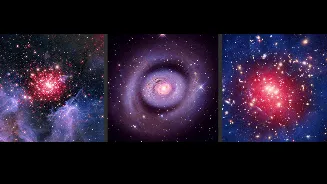
The fresh clue comes from a team of researchers at Northwestern University, who used the powerful Atacama Large Millimeter/submillimeter Array (ALMA) in Chile. By creating the most detailed map ever of the cold gas surrounding Sgr A, they found something remarkable. After carefully subtracting the bright glare of the black hole itself, they uncovered a giant, cone-shaped hole in the gas, pointing directly away from the black hole. This cavity, about three light-years long, is the unmistakable imprint of an active wind pushing material out of its way. Data from NASA's Chandra X-ray Observatory confirmed that this void is filled with hot gas, solidifying the evidence that it was carved out by an outflow from the black hole.
What the Wind Tells Us
Finding this wind is more than just solving an old mystery; it fundamentally changes our understanding of our own cosmic backyard. It confirms that Sgr A, despite its relatively calm and quiet state, behaves like other supermassive black holes across the universe. It's not a strange exception, but a normal example of a black hole in a phase of low activity. Most galaxies spend their lives in this quiet state, but we usually only notice them during their 'fireworks' stages when they are actively feeding and flaring. This discovery gives scientists a unique window into the typical, everyday life of a supermassive black hole. The wind itself, though not as powerful as those seen in more dramatic galaxies, has likely been active for at least 20,000 years, slowly shaping the environment at the galaxy's core.
Putting the Pieces Together
This breakthrough was made possible by combining years of observations with innovative data processing techniques. One researcher noted that when you find something no one has seen before, the first thought is often that something is wrong with your analysis. However, by overlaying the ALMA radio data with Chandra's X-ray data, the team gained confidence that the cone-shaped void was a real feature. The discovery proves that even though Sgr A* is on a meager diet—equivalent to a human eating a single grain of rice over a million years—it still has enough energy to create a noticeable outflow. It shows that all black holes, unless they exist in a perfect vacuum, must produce some kind of wind.