




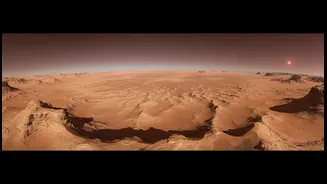


The Ghost of an Ocean
For decades, scientists have debated the existence of a primordial Martian ocean. While orbiters have spotted features resembling ancient river valleys and deltas, the evidence for a massive, stable body of water has been elusive. Previous searches for a shoreline,
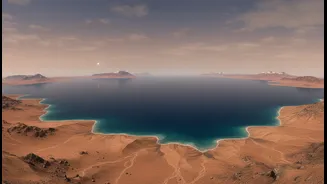
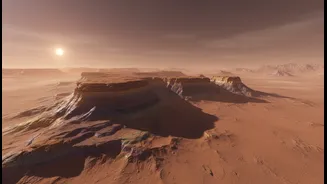
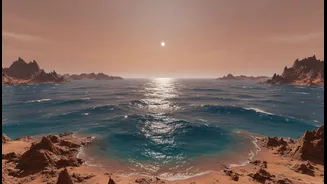
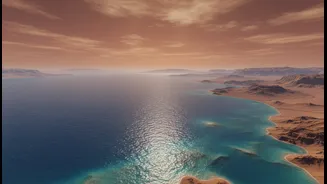
like those on Earth, were complicated by the fact that the elevations of these suspected features varied dramatically. But recent studies have taken a different approach. Instead of looking for a subtle shoreline eroded over billions of years, scientists have identified a much larger and more stable feature: a coastal shelf. Researchers described it as a 'bathtub ring'—a vast, flat band of land that marks the boundary where an ancient ocean would have met the continent, similar to the continental shelves on Earth. This discovery, detailed in the journal Nature, suggests an ocean once covered as much as a third of the planet's northern hemisphere.
Painting a Picture of a Water World
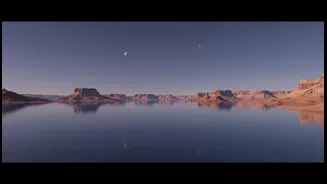
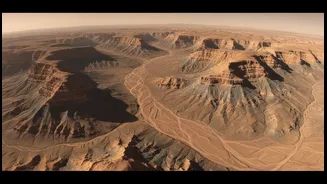
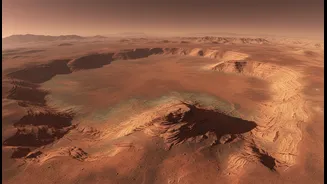
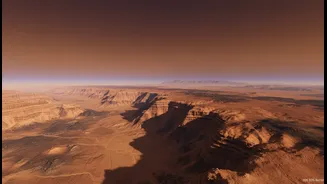
This wasn't a fleeting sea. A landform like a coastal shelf takes a very long time to form, indicating the ocean was likely a stable feature for potentially millions of years. Studies based on topographic data from Mars orbiters suggest this body of water, sometimes called Oceanus Borealis, filled the vast low-lying basin of the planet's northern hemisphere about 3.5 to 4 billion years ago. Other research, analysing minerals and landforms in areas like Valles Marineris—the largest canyon in the solar system—has also found evidence of what appear to be ancient river deltas feeding into a large body of water. Together, these findings paint a picture of a very different early Mars: a planet with a thicker atmosphere, a warmer climate, and enough liquid water to form an ocean that may have held more water than Earth's Arctic Ocean.
The Recipe for Habitability
The presence of a long-lasting ocean dramatically increases the chances that Mars was once habitable. Water is the key ingredient for life as we know it, and a large, stable body of it provides a clement environment for life to potentially emerge and thrive. Beyond just the water itself, the interaction of that water with rock would have created a diverse range of environments. Rovers like Curiosity have already found that some ancient lakebeds contained key chemical ingredients for life, such as sulfur, nitrogen, oxygen, and carbon, in a relatively neutral pH environment. An ocean would have provided a much larger stage for these life-enabling processes to occur. The shorelines and sedimentary deposits left behind by this ocean are now considered prime targets in the search for biosignatures—the preserved signs of ancient microbial life.
Where Did All the Water Go?
If Mars once had an ocean, what happened to it? For a long time, the leading theory was that the water was lost to space. Without a protective global magnetic field, solar winds slowly stripped away Mars's atmosphere, causing the planet to cool and its water to evaporate and escape. While atmospheric escape certainly played a role, newer research suggests another culprit. A significant portion of Mars's ancient water—perhaps between 30 and 99 percent—may not have escaped at all. Instead, it became trapped within minerals in the planet's crust through a process called crustal hydration. On Earth, this water is recycled back into the atmosphere via plate tectonics and volcanism. But Mars is tectonically inactive, so once the water was locked into the rock, it was a permanent change, leaving the surface the dry, frozen desert we see today.