




What is a Spin State?
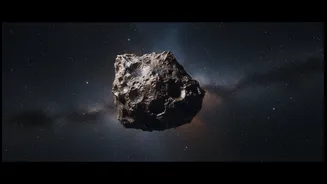
Imagine an asteroid as a spinning top in space. Its 'spin state' is essentially a detailed description of its rotation. This includes not just how fast it's spinning, but also whether it has a wobble. A stable asteroid spins smoothly around a single axis,
like a perfectly thrown football. A disturbed asteroid, however, tumbles chaotically through space, rotating around multiple axes at once. This complex motion, a combination of rotation and wobble (known as precession), gives each asteroid a unique rotational signature that astronomers can measure from Earth. A simple, stable spin suggests a long period of quiet, while a chaotic tumble is a clear sign that something has recently knocked it off-kilter.
The Agents of Disturbance
An asteroid's peaceful spin can be disrupted by two main forces: violent collisions and a subtle, persistent push from sunlight. The solar system is a crowded place, and asteroids are constantly bumping into each other. A significant impact can send an asteroid into a chaotic tumble, much like a car spinning out after a crash. This is the most dramatic way to alter a spin state. The second force is far more delicate. Known as the YORP effect, it's a tiny push generated when an asteroid absorbs sunlight and re-radiates that energy as heat. Because asteroids have irregular shapes and surfaces, this heat isn't emitted evenly, creating a minuscule but constant torque, like an invisible hand gently spinning it. Over millions of years, the YORP effect can cause an asteroid to spin faster and faster until it breaks apart, or it can slow it down.
How Scientists Read the Spin
Astronomers don't need to visit an asteroid to know how it's spinning. They can determine its spin state by carefully observing its 'light curve'. As an asteroid tumbles through space, the amount of sunlight it reflects toward Earth changes. By measuring these fluctuations in brightness over time, scientists can create a graph—the light curve—that reveals the asteroid's rotation period and wobble. A simple, repeating pattern indicates a stable rotator, while a complex and irregular light curve points to a chaotic tumbler. Powerful instruments like the European Space Agency's Gaia satellite and the Vera C. Rubin Observatory are now generating massive databases of these light curves, allowing scientists to analyze the spin states of thousands of asteroids at once.
A Window into an Asteroid's Past
The spin state is a powerful historical record. Recent studies have shown a clear divide in the asteroid population: faster-spinning asteroids tend to be stable, while slower ones are often found tumbling chaotically. This is because a slow rotator is more easily knocked into a tumble by even a small collision, and it lacks the internal friction to quickly stabilize itself. A fast, chaotic spin, therefore, often points to a recent and violent impact. In contrast, an asteroid with a very fast but stable spin might be a solid chunk of rock, strong enough to withstand the centrifugal forces that would tear a looser 'rubble pile' asteroid apart. Some may be remnants of larger bodies shattered in ancient cosmic crashes. By categorizing asteroids this way, scientists can piece together the history of collisions in different parts of the solar system.
Why This Cosmic Detective Work Matters
Understanding an asteroid's spin isn't just an academic exercise. It has crucial real-world implications. Firstly, it helps us map the evolution of our solar system, revealing how objects have moved and interacted over billions of years. Secondly, it tells us about the internal structure of asteroids. Knowing whether an asteroid is a solid monolith or a loosely-held-together pile of rubble is critical for planetary defense. A mission to deflect a hazardous asteroid, like NASA's DART mission, would need to account for this; a rubble pile might absorb an impact differently than a solid rock. As major sky surveys discover millions of new asteroids, reading their spin states will be a key tool for identifying potential threats and understanding the ancient worlds in our own cosmic backyard.