

Our Star's Boiling Surface
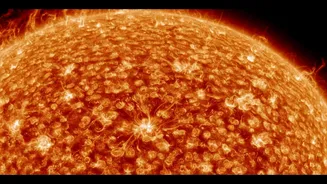
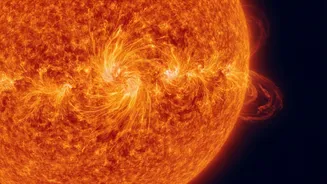
Imagine a pot of water boiling, but on a cosmic scale. That's a simplified way to think about the surface of our Sun. This 'boiling' creates a grainy pattern known as granulation. Each 'grain', or solar granule, is actually the top of a massive convection
cell. These cells are enormous, with a typical granule spanning about 1,500 kilometers—roughly the size of a large country. Hot plasma from the Sun's interior rises in the bright center of each granule, spreads out, cools, and then sinks back down along the darker, cooler edges. This entire process is remarkably fast; an individual granule lasts for only about 8 to 20 minutes before dissipating and being replaced by a new one. At any given moment, the Sun's surface is covered by millions of these constantly shifting cells.
A Sharper Look Than Ever Before
The latest, groundbreaking images were captured by the National Science Foundation's Daniel K. Inouye Solar Telescope in Hawaii, the most powerful solar telescope in the world. While the headline mentions NASA, which partners on and utilizes data from such projects, the telescope itself is an NSF facility. These new visible-light pictures are the highest-resolution images of the solar surface ever taken, capable of showing features as small as 20 kilometers across. To put that in perspective, previous top-tier images could resolve details around 30 kilometers. This leap in clarity is allowing scientists to move beyond theory and directly observe phenomena on the Sun's surface that were previously too small to see.
Discovering a Hidden Instability
What do these sharper images reveal? For the first time, scientists have confirmed the existence of a long-theorized phenomenon called the Kelvin-Helmholtz instability (KHI) on the Sun. This instability creates swirling vortices—like tiny whirlpools—when two streams of plasma flow past each other at different speeds. These 'breaking waves' have been seen in clouds and oceans on Earth, and even on other planets like Jupiter, but confirming them on the Sun is a major breakthrough. The new images show these swirls and streaks clustering at the edges of the solar granules, a discovery that was impossible without the telescope's incredible resolution.
Solving a Decades-Old Mystery
This discovery is more than just an interesting visual; it could help solve one of the biggest mysteries in solar physics: the coronal heating problem. For decades, scientists have been puzzled as to why the Sun's outer atmosphere, the corona, is hundreds of times hotter than its visible surface. The newly observed Kelvin-Helmholtz instabilities could be a key part of the answer. These instabilities may provide a mechanism for transferring energy from the Sun's surface up into the corona, effectively heating it to millions of degrees Celsius. Understanding this process is crucial not only for our knowledge of stars but also for improving our ability to predict space weather, like solar flares, which can impact technology on Earth.