





A Cosmic Sibling Under the Microscope
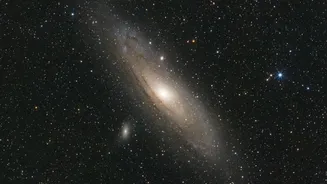
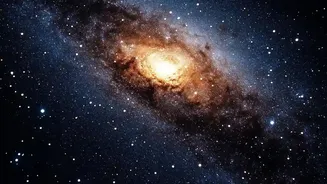
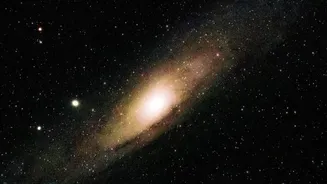
At a distance of about 2.5 million light-years, the Andromeda galaxy is the most distant object visible to the naked eye from Earth. For astronomers, it offers a unique opportunity: it’s close enough to be studied in incredible detail, yet far enough that
we can see its entire structure. This makes it the perfect laboratory for understanding how large spiral galaxies like our own Milky Way evolve. Two ambitious surveys using the Hubble Space Telescope, the Panchromatic Hubble Andromeda Treasury (PHAT) and its southern counterpart (PHAST), have created an unprecedented map of our neighbour, resolving a staggering 200 million individual stars.
Reading the Fossil Record of Stars
Stars act as a fossil record, preserving the history of their galaxy. To read this record, astronomers analysed the colours of the stars across Andromeda's disk. Massive stars burn hot and blue, but have very short lives, so their presence indicates recent star birth. Less massive, longer-lived stars glow redder, signifying older populations. By dividing the galaxy into thousands of small regions and analysing the mix of stars in each, scientists were able to reconstruct a detailed timeline of star formation activity stretching back hundreds of millions of years.
A Slow and Steady Decline
The study revealed a surprising trend. While previous research showed Andromeda experienced a massive burst of star formation about 2 billion years ago, likely from a galactic merger, its more recent history is one of steady decline. Over the last 500 million years, its star birth rate has been consistently dropping. Around 500 million years ago, Andromeda was creating stars at a rate of about one solar mass per year, similar to the Milky Way's current output. However, that rate has now plummeted to just one-fifth of a solar mass per year. The decline has become even more pronounced in the last 40 million years.
The Fading of a Fiery Ring
The slowdown isn't happening uniformly across the galaxy. Much of the decline is driven by fading activity within a prominent star-forming ring located about 32,000 light-years from the galactic centre. This ring has been responsible for a large portion of Andromeda's recent star birth, so as it quiets down, the entire galaxy's average rate drops with it. Researchers say this isn't because the galaxy is running out of the gas and dust needed to make stars, but rather seems to be a natural winding-down phase after its more active past. As one lead author put it, it's like taking a breather after running a marathon.
A Tale of Two Galaxies
This discovery sharpens the contrast between Andromeda and our own Milky Way. While Andromeda is slowly entering a quieter phase of its life, our galaxy is comparatively active, still churning out new stars at a steady pace. The study also hinted at a possible cause for a localised dip in star formation: the small satellite galaxy M32. Regions of Andromeda closest to M32 showed a decreased rate of star birth beginning around 60 million years ago, suggesting a past interaction may have disturbed the area, though astronomers say M32 is a suspect, not yet a confirmed cause.