




A Panoramic Window on the Cosmos
Imagine trying to take a picture of an entire mountain range, but your camera can only capture a single tree at a time. For decades, this has been the challenge for space telescopes like Hubble, which provide incredibly deep but narrow views of the universe.
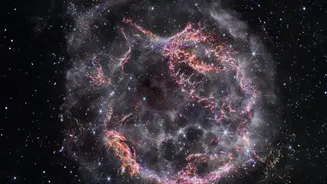
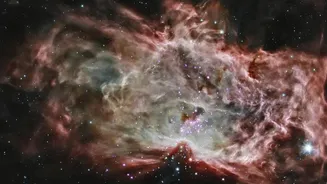
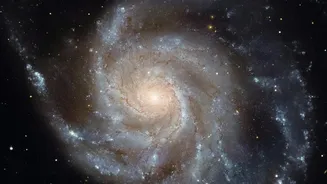
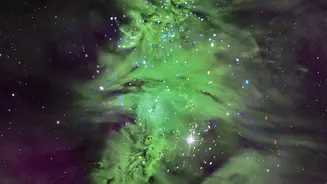
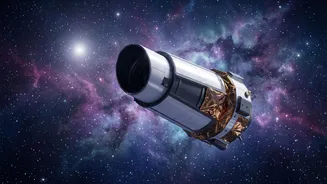
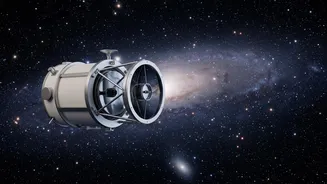
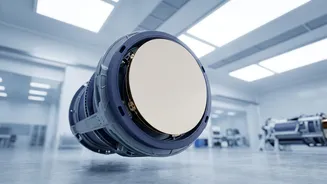
The Nancy Grace Roman Space Telescope changes the game entirely. While its 2.4-meter primary mirror is the same size as Hubble's, its Wide-Field Instrument gives it a field of view at least 100 times larger. In the time it takes Hubble to photograph a sliver of the sky, Roman can capture a vast panorama with the same stunning, high-resolution clarity. This means that for the first time, astronomers will be able to create enormous, detailed maps of the universe, revealing millions of galaxies in a single observation instead of assembling a mosaic piece by tiny piece.
Journey to a Cosmic Vantage Point
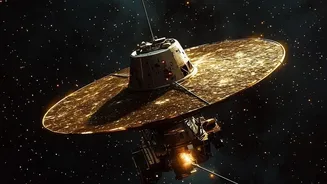
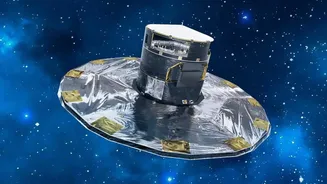
The journey for Roman began with a spectacular launch aboard a SpaceX Falcon Heavy rocket from Florida. It is now cruising toward its final destination: the second Sun-Earth Lagrange Point (L2), a gravitationally stable spot about 1.5 million kilometers from Earth. This location, also home to the James Webb Space Telescope (JWST), allows the observatory to maintain a steady view of deep space while conserving fuel. The telescope is currently in a commissioning phase, a period of about three months where engineers on the ground will test its systems, deploy its sunshade, and activate its instruments. NASA is providing a real-time online tracker for the public to follow its journey. If all goes according to plan, the world can expect to see the first stunning images from Roman in early 2027, officially kicking off its five-year primary mission.
Hunting for Dark Energy and New Worlds
Roman is more than just a powerful camera; it's a dedicated detective designed to investigate two of the biggest mysteries in modern science: dark energy and exoplanets. About 68% of the universe is made of dark energy, a mysterious force causing cosmic expansion to accelerate, but we know very little about it. By surveying hundreds of millions of galaxies, Roman will measure how the universe has expanded over time, providing crucial data to help scientists understand the nature of this force. Its second major goal is to conduct a massive census of planets outside our solar system. Using a technique called gravitational microlensing, Roman can detect planets that are too small or too far from their star to be found by other methods. It's expected to discover thousands of new worlds, from gas giants to rocky planets, and may even find 'rogue' planets that wander through space untethered to a star.
A New Partner in Cosmic Discovery
Roman is not a replacement for telescopes like Hubble or JWST, but a powerful new partner. Its capabilities are designed to be complementary. While JWST excels at making incredibly deep, focused observations of specific targets, Roman is a survey instrument built for speed and scale. It will rapidly scan huge sections of the sky, identifying countless new objects and phenomena. These discoveries will then provide a rich catalog of targets for JWST and other telescopes to study in greater detail. Named after Nancy Grace Roman, NASA's first chief of astronomy and the “Mother of Hubble,” the telescope carries on her legacy of pushing the boundaries of space exploration. With its advanced Coronagraph Instrument, which can block a star's light to directly image faint planets orbiting it, Roman will also test technology for future missions aimed at finding habitable, Earth-like worlds.