






What is Happening Deep Inside Earth?
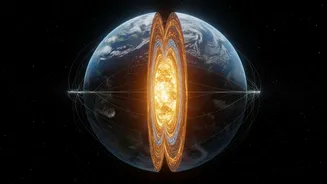
Our planet has a layered structure, with a solid inner core surrounded by a liquid outer core composed mostly of molten iron and nickel. This liquid metal is in constant, turbulent motion. This movement of electrically conducting liquid generates Earth's
magnetic field in a process called a geodynamo. For decades, observations suggested that this flow was dominated by a steady westward drift. However, recent analysis has revealed a startling deviation. Around 2010, a huge swathe of this molten river, located about 2,200 kilometres beneath the Pacific Ocean, unexpectedly reversed course and began flowing eastward at an accelerating pace.
How Can Satellites 'See' the Core?
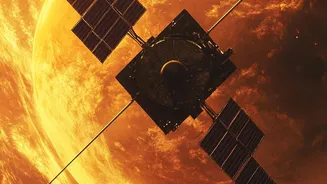
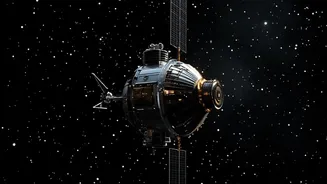
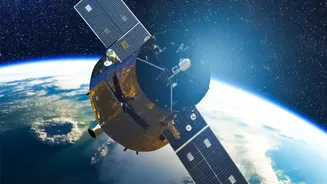
Satellites cannot see the core directly, but they can precisely measure its most significant effect: Earth’s magnetic field. The European Space Agency's (ESA) Swarm mission, a trio of identical satellites launched in 2013, carries highly sensitive instruments for this purpose. By flying in precise orbits, the Swarm constellation can distinguish the magnetic signals coming from the core from the magnetic noise generated by the crust, oceans, and atmosphere. By tracking subtle changes and sudden accelerations—known as "geomagnetic jerks"—in the magnetic field over many years, scientists can reconstruct the flow patterns of the liquid core below. The recent discovery combined over two decades of data from Swarm and other missions like CHAMP and Ørsted to map these deep-Earth movements.
Why Does This Matter for Our Planet?
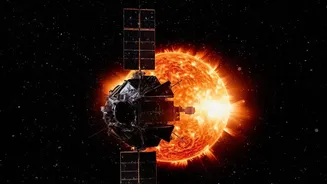
The core's behaviour is fundamentally important to life on the surface. The magnetic field it generates acts as a protective shield, deflecting harmful charged particles from the sun known as the solar wind. Without this shield, our atmosphere and technological infrastructure would be much more vulnerable to damaging solar radiation. Sudden changes in the core flow, like the observed reversal, can lead to rapid, unpredictable shifts in the magnetic field. These events complicate efforts to model and forecast the field's evolution, which is crucial for everything from smartphone navigation to spacecraft operations. Understanding these dynamics helps us better prepare for changes in our planet's magnetic shield.
A Surprising Link to the Length of a Day
The Earth’s rotation isn’t perfectly constant; the length of a day fluctuates by tiny amounts. While many factors are involved, such as winds and ocean currents, scientists have found a strong connection between the core's motion and variations in the length of a day over periods of one to ten years. The planet’s core and its solid mantle are coupled, meaning a change in the speed of the core's rotation can cause the surface to rotate slightly faster or slower to conserve angular momentum. In fact, a recent slowdown in the rotation of the solid inner core since 2010 coincides with the period when the outer core's flow reversal was observed, suggesting these deep-Earth events may be linked.
A New Window Into the Deep Earth
This discovery does more than just document a single event; it transforms our understanding of the planet's interior. It shows that the core is far more dynamic and variable than previously thought, with regional changes capable of emerging in just a decade. What scientists once saw as a relatively stable system is now revealed to be a place of rapid, complex behaviour. The data suggests the eastward flow may already be weakening, raising the possibility that this reversal is part of a longer, mysterious natural cycle. This newfound ability to monitor the geodynamo in near-real-time opens up exciting new avenues for research, helping scientists probe the connections between the liquid outer core, the solid inner core, and the mantle above.