




A New Eye on the Cosmos
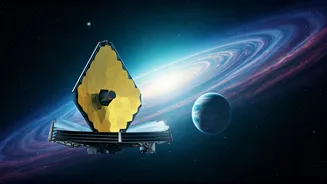
Scheduled to launch by May 2027, the Nancy Grace Roman Space Telescope is an observatory with a grand mission. Named after NASA's first chief of astronomy, the so-called 'Mother of Hubble', this telescope is designed to tackle some of the biggest questions
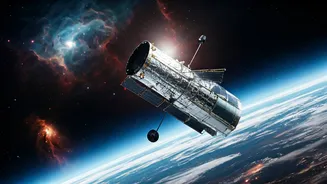
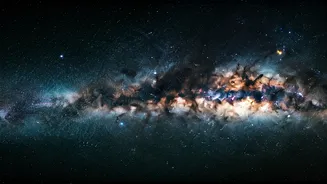
in astrophysics, including the nature of dark energy and the census of planets beyond our solar system. Its primary mirror is the same size as the Hubble Space Telescope's, 2.4 meters in diameter, but its capabilities are a world apart. The Roman Telescope will observe the universe in infrared light, allowing it to peer through cosmic dust clouds that obscure the view for telescopes that see in visible light. This ability will be crucial for one of its key missions: surveying the crowded, dusty heart of our own Milky Way galaxy.
The Power of a Panoramic View
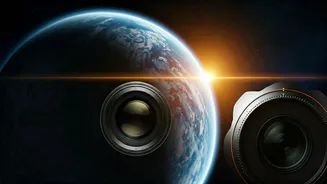
The key difference between Roman and its famous predecessors, Hubble and the James Webb Space Telescope (JWST), is its field of view. Think of Hubble and Webb as powerful telephoto lenses, able to zoom in and capture incredibly deep, detailed images of small patches of the sky. Roman, by contrast, is a wide-angle lens. Its Wide Field Instrument will capture an area of the sky at least 100 times larger than Hubble can in a single snapshot, all while maintaining a similar, razor-sharp resolution. This panoramic capability means Roman can map the sky at a blistering pace, collecting data up to 1,000 times faster than Hubble. A single image from Roman will contain the detail equivalent to 100 Hubble pictures. This efficiency will allow it to conduct vast surveys that would be impractical for other telescopes, creating cosmic panoramas of unprecedented scale.
Mapping the Milky Way's Heart
So, where do the billions of stars come in? One of Roman's primary missions is the Galactic Bulge Time-Domain Survey. This project will repeatedly scan the dense central hub of our Milky Way galaxy, a region packed with stars. Using its infrared vision, Roman will pierce through the intervening dust to monitor hundreds of millions of stars. Over its mission, the telescope's various surveys are expected to build a catalogue of up to 20 billion stars. It will observe stars at all stages of life, from stellar embryos to ancient suns, providing a comprehensive history of star birth and evolution in our galaxy’s core. This will create a star catalogue an order of magnitude larger than current ones, giving us the deepest view into the heart of the Milky Way ever achieved.
Hunting for a Hundred Thousand Worlds
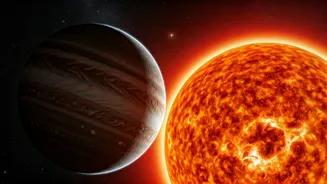
Beyond simply mapping stars, Roman's survey of the galactic center will be a revolutionary planet-hunting machine. It will use two main techniques. The first is the transit method, where it watches for the slight dimming of a star as a planet passes in front of it. Scientists expect Roman to find roughly 100,000 new planets this way. Its second method is called gravitational microlensing. This technique relies on a cosmic coincidence: when a star and its planet pass in front of a more distant background star, their combined gravity acts like a natural magnifying glass, causing the background star's light to temporarily brighten. Microlensing is especially good at finding planets far from their stars, including worlds similar to those in our own solar system and even 'rogue' planets that wander the galaxy alone. Roman is predicted to find thousands of exoplanets using this powerful technique, completing a census of the types of worlds that grace our galaxy.
Beyond the Stars: The Dark Universe
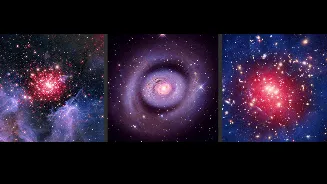
While mapping stars and finding planets are headline-grabbing goals, Roman's primary mission is arguably even more profound: to investigate the mysteries of dark energy and dark matter. These enigmatic components are thought to make up about 95% of the universe, yet we know almost nothing about them. Roman will use its wide-angle view to map the large-scale structure of the universe, observing how billions of galaxies are distributed and how their light has been bent by the gravity of unseen dark matter. By studying distant exploding stars called supernovae, it will also measure how the expansion of the universe has changed over cosmic history. These observations will provide critical new data to test our theories about the fundamental forces that govern the cosmos.