








Beyond Lasers and Explosions
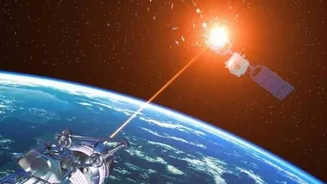
When we talk about orbital weapons, it's crucial to move past the sci-fi imagery. The reality is both more mundane and more dangerous. Today's orbital threats are not necessarily weapons that sit in space waiting to be fired, but a spectrum of capabilities
designed to disrupt, degrade, or destroy satellites. These include direct-ascent anti-satellite (ASAT) missiles, which are launched from the ground to physically destroy a target in orbit. The United States, Russia, China, and India have all successfully demonstrated this capability. Then there are co-orbital systems, sometimes called 'inspector' satellites, that can maneuver close to another country's satellite to spy on, interfere with, or physically damage it. Beyond these kinetic options, there are non-kinetic attacks like electronic jamming, cyber-attacks on ground control systems, and high-powered lasers or microwave weapons that can blind a satellite's sensors without creating a debris field.
The Blurring Line of Dual-Use Technology
One of the greatest challenges in managing the orbital weapons story is the problem of dual-use technology. It's incredibly difficult to define what a 'space weapon' is when up to 95% of space technologies can have both civilian and military applications. A satellite designed for on-orbit servicing with a robotic arm to repair a friendly satellite or remove space junk could just as easily be used to grab and disable an adversary's asset. A commercial satellite providing internet services can also be an indispensable tool for battlefield communications, as seen with Starlink. This ambiguity makes arms control incredibly difficult. A country can develop and test seemingly peaceful technologies for rendezvous and proximity operations that are, in effect, undeclared weapons capabilities. This gray area is where much of the current competition is unfolding, as it allows nations to advance their strategic capabilities without explicitly violating the letter of international law.
The State of Play in Orbit
The weaponization of space is not a future hypothetical; it's a present-day reality. The four nations that have demonstrated a kinetic ASAT capability—the US, China, Russia, and India—represent the core of this strategic shift. Russia has tested its Nudol ground-launched ASAT system and is believed to be developing co-orbital systems and ground-based lasers. China has also shown advanced capabilities, including missiles capable of reaching high-orbit satellites and a series of Shijian satellites that have performed sophisticated proximity maneuvers. India joined this club with its 'Mission Shakti' test in 2019, demonstrating its own ASAT missile and signaling its intent to secure its space assets. In a significant policy shift, the US officially confirmed in September 2026 that it has deployed 'on-orbit space control weapons,' though specifics were not disclosed. This announcement confirms what experts long suspected and signals a new, more transparent phase in the orbital arms race.
A New, Unstable Strategic Domain
The movement of weaponized technology into orbit fundamentally changes geopolitics. Modern economies and militaries are deeply dependent on satellites for everything from GPS navigation and financial transactions to intelligence gathering and missile early warning. This dependence creates a critical vulnerability. An attack on a nation's satellite infrastructure could cripple its ability to function without firing a single shot on Earth. This new strategic instability is compounded by a weak international legal framework. The 1967 Outer Space Treaty prohibits placing weapons of mass destruction in orbit but does not explicitly ban conventional weapons. Efforts at the United Nations to prevent an arms race in outer space have been slow, bogged down by the definitional problems of dual-use technology and a lack of trust between major powers. The result is an environment where every major space-faring nation feels compelled to develop its own counter-space capabilities as a deterrent, creating a classic security dilemma that makes conflict more, not less, likely.