


A Star’s Final Choice
For stars much more massive than our Sun, the end of life is a dramatic affair. After millions of years of fusing lighter elements into heavier ones, their fuel runs out. Without the outward pressure from nuclear fusion, gravity wins, and the star’s core
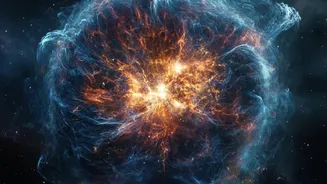
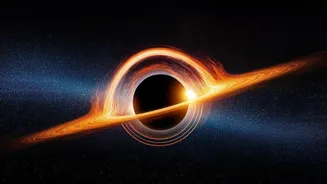
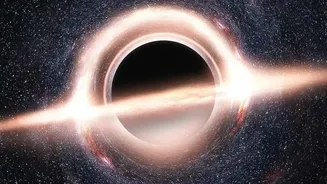
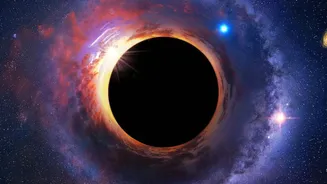
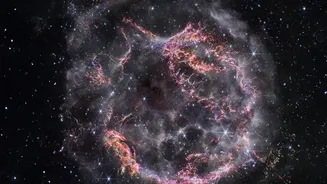
collapses catastrophically. This implosion triggers one of two outcomes. In some cases, the collapse rebounds, blasting the star's outer layers into space in a brilliant supernova, leaving behind an ultra-dense neutron star. In other cases, the collapse is unstoppable, and the star implodes completely, forming a black hole. For decades, astrophysicists have worked to understand what tips the scales between these two fates. Now, a study from the University of Copenhagen suggests a previously underestimated player has a major role: the neutrino.
The Universe’s Ghost Particle
Neutrinos are fundamental particles, often called ‘ghost particles’ because they barely interact with anything. Trillions of them pass through your body every second without a trace. They are produced in extreme cosmic events, including the fiery heart of a collapsing star. When a star’s core implodes, it releases a staggering flood of neutrinos—so many that, despite their weak nature, they carry away about 99% of the collapse's energy. A small fraction of these neutrinos slam into the material just outside the core, heating it up. If this heating is strong enough, it can power a supernova explosion. If not, the material falls back, and a black hole is born.
A Quantum Costume Change
Here's where it gets interesting. Neutrinos come in three types, or ‘flavours’: electron, muon, and tau. Furthermore, thanks to a quantum phenomenon called oscillation, they can spontaneously change from one flavour to another as they travel. This is crucial because different flavours interact with matter differently. Electron neutrinos are the most interactive, while muon and tau neutrinos are much less so. Previously, scientists believed that the dense environment of a collapsing star would prevent these flavour changes, or that they would have a negligible effect. However, recent research shows that when neutrinos are packed together in extreme numbers, they can interact with each other, triggering rapid flavour conversions.
The Moment of Truth
The new study simulated the collapse of 195 stars, ranging from nine to 120 times the mass of our sun, to see how these flavour changes affected the outcome. The results were surprising. When flavour conversions were included in the models, a significant number of stars that were expected to explode as supernovae instead failed and collapsed into black holes. This effect was especially strong for stars between 16 and 30 times the mass of the Sun. The flavour-changing neutrinos were less effective at heating the surrounding matter, robbing the potential explosion of the power it needed to succeed. According to study co-author Irene Tamborra, many stars in this mass range, which explode comfortably in standard simulations, fail to do so once flavour conversion is factored in.
A New Cosmic Blueprint
This discovery could help solve several long-standing cosmic mysteries. For example, astronomers have observed fewer supernovae in the universe than our theories predict. If more massive stars are collapsing directly into black holes, as this research suggests, it could explain the discrepancy. It may also explain why some giant stars seem to simply vanish without a trace—they aren't exploding, but imploding. By providing a more accurate picture of a star’s final moments, this research changes our understanding of how black holes are born and how the elements forged inside stars are distributed across the cosmos. It introduces a critical new variable into the models that map the life and death of the universe's most massive objects.