





What is NavIC and Why Does It Matter?
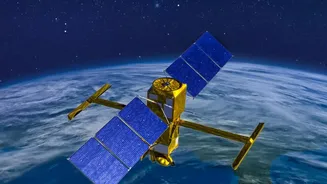
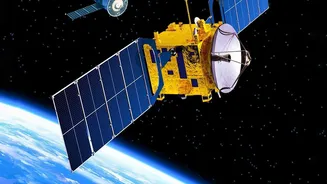
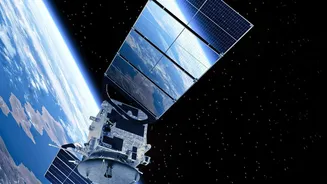
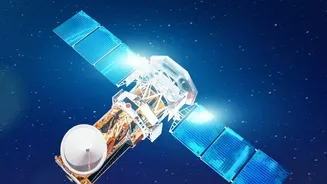
Think of NavIC (Navigation with Indian Constellation) as India’s answer to the American GPS. Developed by the Indian Space Research Organisation (ISRO), it's a regional satellite navigation system designed to provide accurate positioning and timing services
over India and a region extending 1,500 kilometres beyond its borders. The system was born from a crucial strategic lesson learned during the 1999 Kargil War, when access to foreign-owned satellite navigation data was not guaranteed. Having a sovereign system means India doesn't have to depend on other nations for critical navigation, which is vital for both military operations and civilian applications. It offers two services: a Standard Positioning Service (SPS) for all users and an encrypted Restricted Service (RS) for strategic use by the armed forces.
A Constellation in Trouble
A navigation system’s accuracy depends on a simple principle: a receiver on the ground needs signals from at least four satellites to calculate a precise position. The original NavIC constellation was designed with seven operational satellites. However, the system has been plagued by a series of setbacks, primarily the failure of imported atomic clocks on several of the first-generation (IRNSS) satellites. These clocks are the heart of any navigation satellite, providing the ultra-precise timekeeping needed to calculate location. Due to these failures, the number of fully functional satellites providing positioning services dropped to just three (IRNSS-1B, IRNSS-1I, and NVS-01), which is below the minimum required for standalone navigation. This effectively rendered NavIC's independent positioning service inactive, forcing users to rely on a multi-constellation approach that includes foreign systems like GPS.
Enter NVS-03: The Next-Generation Solution
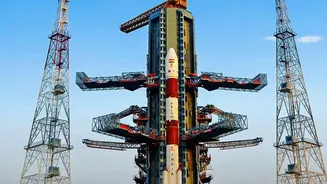
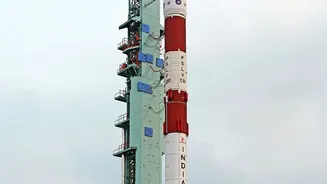
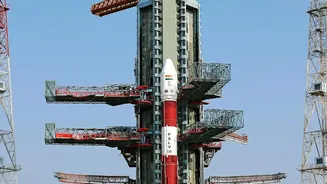
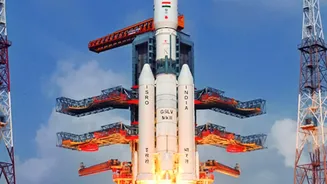
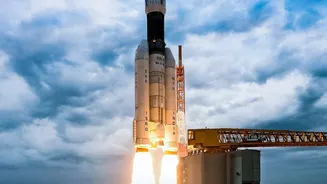
NVS-03 is the latest satellite in India's second generation of navigation satellites, designed specifically to replenish and strengthen the NavIC constellation. A successful launch, targeted for mid-October 2026, would bring the number of operational satellites back to the crucial threshold of four, reactivating its standalone positioning services. The NVS series satellites are a significant upgrade over their predecessors. For the first time, they incorporate indigenously developed rubidium atomic clocks, which are expected to be more reliable than the imported ones that failed in earlier satellites. NVS-03 is also designed for a longer mission life of 12 years and broadcasts on the L1 frequency band, the same band used by GPS for civilian signals. This makes it much easier for consumer devices like smartphones to receive NavIC signals without needing special, dedicated hardware.
What Full Strength Means for India
Restoring NavIC is about more than just a technical fix; it’s about national security and economic progress. A fully functional NavIC provides the armed forces with a secure, encrypted, and uncompromised navigation service for guiding missiles, coordinating troop movements, and directing naval and air assets without fear of foreign interference. For civilians, it enables a vast range of applications. The system is already mandated for all commercial vehicles in India for tracking purposes. It supports fishermen in identifying maritime boundaries, aids in precision agriculture, enhances disaster management response, and provides critical timing for telecommunication networks and power grids. A robust NavIC encourages wider adoption in the consumer market, sparking innovation and creating a domestic ecosystem around homegrown technology.
The Road Ahead for NavIC
The launch of NVS-03 is a critical step, but it is not the final one. ISRO is already preparing two more satellites, NVS-04 and NVS-05, which are in advanced stages of development. These launches are part of a broader plan to not only restore the original seven-satellite constellation but to expand it. There are long-term plans to take NavIC from a regional system to a global one, similar to GPS or Galileo, which would involve placing an entirely new fleet of satellites into Medium Earth Orbit. This ambitious vision would cement India’s position as a major space power, capable of offering independent, high-accuracy navigation services to the world while ensuring its own strategic needs are always met.