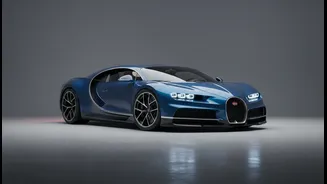






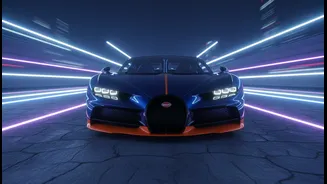
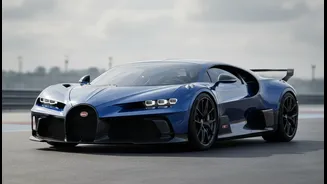


An Uncompromising Track Weapon
The original Bugatti Bolide, revealed in 2020, was an experimental study in the extreme. Built around the legendary 8.0-litre quad-turbo W16 engine, it was stripped of all non-essential components, shedding weight to achieve a jaw-dropping power-to-weight
ratio. The concept boasted a theoretical 1,825 horsepower using 110-octane racing fuel, with a minimalist carbon fibre body designed to generate immense downforce. It was a car never intended to see a public road, with a design so aggressive it resembled a fighter jet more than a production vehicle, complete with racing slicks and a track-focused suspension. Bugatti's only goal was to create the ultimate track driving machine, unbound by the regulations and compromises of street legality.
The Challenge of Domestication
Turning the Bolide from a track-only special into a car that could wear a number plate was a task undertaken not by Bugatti, but by British engineering firm Lanzante, renowned for such conversions. The process required significant modifications. To handle the imperfections of public roads, the rigid track-tuned suspension had to be softened to cope with speed bumps and potholes. The original racing slicks, which wear out in under 60 kilometres, were swapped for more durable road-legal tyres. Since the concept lacked traditional road lights, Lanzante cleverly engineered and integrated new custom LED headlights into the Bolide’s dramatic X-shaped front fascia to meet legal requirements.
Power for the People (Who Use Pumps)
While Lanzante handled the road-legal conversion, Bugatti had already made a key change for the limited production run of 40 cars. The final Bolide was tuned to run on standard 98 RON premium gasoline rather than specialised racing fuel. This brought the power output down from the concept's theoretical 1,825 hp to a still-monumental 1,578 hp. Fortunately, this detuning meant the W16 engine was already compliant with many road emissions standards, as it is fundamentally the same powerhouse used in the road-legal Chiron. This decision by Bugatti made Lanzante's job much easier, as they could focus on the physical changes needed for road use without having to extensively re-engineer the powertrain.
A Cockpit of Practical Insanity
The term 'practicality' is relative, but inside the Bolide, it means having more than a bare-bones racing shell. The production car's interior, while still minimalist, was designed with some concessions to comfort, which added weight compared to the prototype. It features two fixed seats moulded directly into the carbon fibre monocoque, but the steering wheel and pedals are adjustable to fit the driver. Unlike many track cars, it includes a climate control system, with vents cleverly styled to resemble the car's exhaust outlets. The unique X-shaped steering wheel is removable and contains essential controls, while a digital display provides the driver with necessary information, striking a balance between a pure racing feel and the basic amenities needed for a road journey.
Still Absolutely Mad
Despite the adjustments for road use, the Bolide has lost none of its core madness. With 1,578 horsepower and a dry weight of just 1,450 kg, its performance remains otherworldly. The car can accelerate from 0 to 100 km/h in just 2.2 seconds. While the production car's top speed is electronically limited to a lower figure than the concept's wild projections, it remains one of the fastest and most extreme vehicles ever made available for public roads. The conversion by Lanzante doesn’t domesticate the beast so much as it gives it a longer leash, allowing its owner to experience a Le Mans-level thrill on the way to a Sunday coffee—for a price tag well north of the original €4 million.