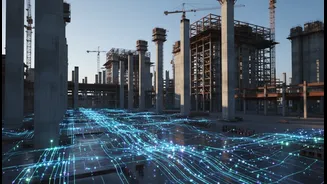










The Global Gold Rush for Chips
Spurred by the painful shortages of the early 2020s and massive government incentives like the US CHIPS Act, a historic construction boom is underway. Companies like TSMC, Intel, and Samsung are investing staggering sums—tens and even hundreds of billions
of dollars—to build new, advanced chip fabrication plants in the US, Asia, and Europe. The goal is simple: to secure supply chains and meet the voracious, AI-driven demand for ever-more-powerful chips. Industry association SEMI projects a record-breaking $156 billion will be spent on manufacturing equipment in 2027, a clear signal of this massive expansion.
The Industry's Famous Boom-and-Bust Cycle
The semiconductor industry has always been notoriously cyclical, prone to dramatic swings between boom and bust. It's a pattern driven by a fundamental mismatch in timing. A surge in demand leads to shortages and high prices. In response, manufacturers commit to massive capital expenditures to build new capacity. The problem is that these new fabs take a very long time to build and bring online. By the time all the new supply arrives, demand may have cooled, leading to overcapacity, a price crash, and a painful downturn. This cycle has repeated itself roughly every three to four years for decades.
Why 2027 Looks Like a Tipping Point
Many industry analysts are pointing to 2027 as the year the current boom may turn to bust. The wave of new fabs that began construction between 2023 and 2025 are expected to come online and ramp up to volume production right around this time. For example, major projects from Intel in Arizona and TSMC's advanced 1.4nm fab are targeting 2027 or 2028 for production. While some, like memory manufacturer SK Hynix, predict a supply crunch in 2027 due to explosive AI demand, others fear the opposite. The concern is that if AI-related revenue doesn't justify the immense infrastructure spending, or if demand in other sectors like automotive and PCs softens, the industry could face a sharp correction when all this new capacity hits the market simultaneously.
Building a Fab is a Marathon, Not a Sprint
The core of the issue is the sheer complexity and timeline of modern fab construction. Building a state-of-the-art facility is a three-to-five-year process costing upwards of $20 billion. This includes not just erecting the building but also installing hyper-sensitive cleanrooms and qualifying incredibly complex lithography tools. This timeline is often extended by significant bottlenecks. The industry is facing a severe shortage of skilled workers, with a projected deficit of up to 157,000 workers in the US by 2030, which threatens to delay projects. Furthermore, there are long lead times for essential manufacturing equipment and even upstream components like power chips and capacitors, creating new chokepoints in the supply chain.
The Peril of a Supply Glut
If a supply peak, or glut, does materialize in 2027, the consequences could be severe for the chipmakers who have bet billions on expansion. An oversupply of chips would inevitably lead to falling prices, squeezing profit margins and potentially making these multi-billion dollar fabs unprofitable. We've seen this movie before. A glut can force companies to slash spending, delay or cancel planned projects, and lead to a significant industry downturn. While lower chip prices might sound good for consumers, the resulting industry instability can stifle the long-term investment needed for the next generation of innovation. The current AI-fueled demand has some executives believing this cycle is broken, but history suggests caution.