




A Mission to the Martian Moons
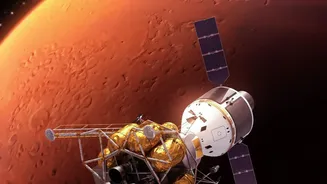
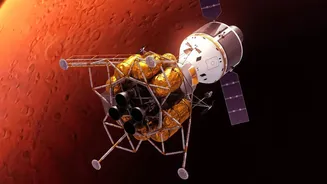
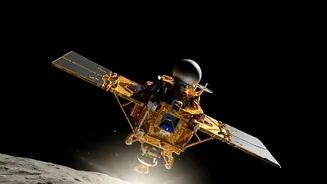
The Japanese Aerospace Exploration Agency (JAXA) is leading the Martian Moons eXploration (MMX) mission, an ambitious project to investigate Phobos and Deimos. Scheduled to launch in 2026, the spacecraft will orbit Phobos, land on its surface to collect
a sample, and then return that sample to Earth by 2031 for analysis. The mission also includes multiple flybys to study the smaller moon, Deimos. This will be the first time a mission has landed on and returned material from a Martian moon, promising an unprecedented look into the history of the Red Planet's neighborhood.
NASA's Key Contribution: MEGANE
At the heart of NASA's involvement is an instrument named MEGANE, which stands for Mars-moon Exploration with GAmma rays and NEutrons. Pronounced 'meh-gah-nay', the name is also the Japanese word for 'eyeglasses', a fitting description for an instrument designed to see what the moons are made of. Developed by a team at the Johns Hopkins Applied Physics Laboratory, MEGANE is a spectrometer that will measure the elemental composition of Phobos' surface from orbit. NASA delivered the completed instrument to JAXA for integration with the MMX spacecraft, marking a critical milestone in this international collaboration.
How to 'See' a Moon's Composition
So how does MEGANE work? It doesn't take pictures. Instead, it detects gamma rays and neutrons that are naturally emitted from the moon's surface. These particles are created when high-energy cosmic rays from deep space constantly bombard the surface of airless bodies like Phobos. The elements in the moon's soil and rock absorb these rays and then emit their own gamma rays and neutrons at specific energy levels. Each element has a unique energy 'fingerprint'. By counting these particles and measuring their energies, MEGANE can create a detailed map of the elements present—such as silicon, iron, potassium, and even signs of water ice—down to a depth of several inches.
Solving the Great Moon Mystery
The data from MEGANE is crucial for solving the central question about Phobos and Deimos: are they captured asteroids, or are they the remnants of a giant impact on Mars billions of years ago? If they are captured asteroids, their composition should be rich in water and organic materials, similar to other objects from the outer solar system. However, if they were formed from the debris of a colossal collision with Mars, the intense heat of that event would have burned off most of those volatile materials. By determining the elemental makeup, MEGANE's findings will provide the key evidence needed to distinguish between these two origin stories.
A Partnership for Discovery
The MMX mission is a prime example of modern space exploration, which relies heavily on international partnerships. While JAXA leads the overall mission, NASA's contribution of the MEGANE instrument is vital to its scientific success. The European Space Agency (ESA), along with the French (CNES) and German (DLR) space agencies, are also providing key components, including a small rover that will land on Phobos. By combining resources and expertise, these agencies can undertake more ambitious and scientifically rewarding missions than any single nation could alone, ultimately expanding our collective understanding of the solar system.