



Meet the Blazar Family
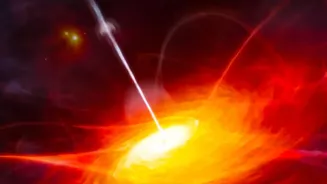
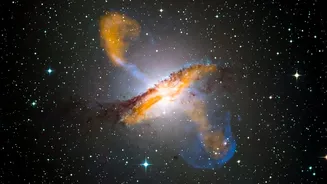
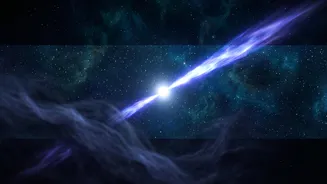
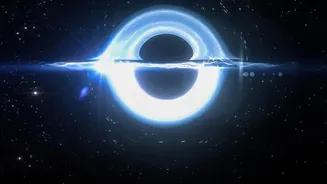
Imagine a supermassive black hole at the heart of a distant galaxy, millions or billions of times the mass of our Sun. As it greedily pulls in gas and dust, it gets messy, blasting out twin jets of energy and particles at nearly the speed of light. When
one of those jets happens to be pointed directly at Earth, we see an object of incredible brightness. This cosmic searchlight is called a 'blazar', and they are among the most energetic phenomena in the universe. For decades, scientists theorised that a smaller version should exist: a 'microblazar'. This would be a similar setup but on a much smaller scale, involving a stellar-mass black hole (perhaps only 10 times the Sun's mass) feeding on a single companion star. But finding one proved to be incredibly difficult.
A 30-Year Cosmic Ghost Hunt
The hunt for a microblazar has been a long and frustrating one for astronomers. The theory was solid, but every potential candidate failed to meet the strict criteria. A true microblazar would need to be a binary system with a black hole, have powerful jets, and—most importantly—have one of those jets aimed almost perfectly at us. An international team of astronomers, however, recently hit the jackpot. Using a network of radio telescopes, including the European VLBI Network, they zeroed in on a system named IRAS 18293-0941, located about 12,000 light-years away in the Milky Way. It was the breakthrough they had been waiting for.
The First Confirmed Sighting
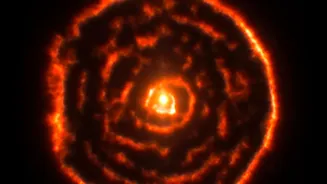
The object, IRAS 18293-0941, ticked all the boxes. It is a binary system where a black hole, about 10 times the mass of our Sun, orbits a massive companion star every 11 days. Just as the theory predicted, the black hole is siphoning material from the star and launching powerful jets travelling at around 75% of the speed of light. Crucially, high-resolution radio observations confirmed that one jet is pointed almost directly toward Earth. The main reason it took so long to find is that the system is shrouded behind a thick veil of interstellar dust, rendering it invisible to conventional optical telescopes. It took the combined power of multiple observatories, looking at different wavelengths of light, to piece the whole story together.
A Cosmic Laboratory in Our Backyard
This discovery is more than just confirming a theory; it provides scientists with a 'cosmic laboratory' right in our own galaxy. Blazars are so distant that it's difficult to study them in detail. Changes in their activity can take thousands of years to observe. But with a microblazar, everything is scaled down. Changes that would take millennia in a blazar can happen on a much shorter, human-observable timescale in its micro counterpart. This allows for an unprecedented opportunity to study the physics of how black holes create and launch these immensely powerful jets. The discovery was the result of a massive international collaboration, with scientists from Spain, the Netherlands, and Argentina leading the effort.
Solving an Ultra-High-Energy Mystery
Perhaps the most exciting implication of this discovery is its potential to solve a major puzzle in astrophysics: the origin of the galaxy's most energetic particles. Our galaxy is filled with mysterious 'PeVatrons'—cosmic accelerators that create particles with energies far beyond anything achievable on Earth. For instance, the jet from IRAS 18293-0941 is estimated to create particles with energies 100 times greater than what can be produced at the Large Hadron Collider. Scientists noticed that this new microblazar is located near a known hotspot of these ultra-high-energy particles. They now believe this is no coincidence. The jet's interaction with a vast cloud of surrounding gas appears to be acting as a colossal particle accelerator, offering a compelling explanation for where these powerful cosmic rays come from.