






A Puzzle of Missing Minis
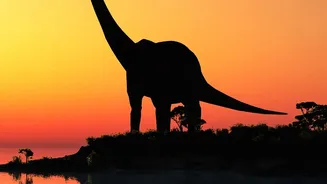
For decades, palaeontologists have been puzzled by a gap in the dinosaur family tree. While they famously evolved into giants, and their avian descendants include tiny hummingbirds, there's a distinct lack of genuinely small non-avian dinosaurs. The smallest
known examples weighed around 400-450 grams, roughly the size of a large rabbit, which is hundreds of times heavier than the smallest mammals and reptiles living today. This absence has always been strange, because in most ecosystems, small-bodied species are typically the most common. A recent study published in the journal Evolution set out to understand why, using mathematical models to predict optimal body sizes based on energy efficiency and reproduction.
Flipping the Competition Script
The models worked well for predicting the common body sizes of modern mammals and birds, but they failed to explain why dinosaurs didn't shrink down to mouse-size. The conclusion, researchers suggest, isn't about biology, but ecology. The study proposes a fascinating role reversal: while giant dinosaurs kept mammals from growing large, our small, shrew-sized ancestors may have outcompeted dinosaurs in the niches for tiny creatures. By dominating the world of insects, seeds, and undergrowth hideouts, early mammals may have effectively created an evolutionary barrier, preventing dinosaurs from getting any smaller. It was a two-way street of competition that shaped the entire Mesozoic era.
Not So Safe in the Dark
This new perspective complicates another long-held idea: the 'nocturnal bottleneck'. This theory suggested that early mammals survived by adapting to life at night, avoiding competition with the sun-loving dinosaurs. However, some evidence suggests this picture is too simple. Discoveries have shown that some small, predatory dinosaurs were also active at night, meaning the darkness was not a guaranteed refuge for mammals. One fossil of the small dinosaur Sinosauropteryx was even found with the jawbone of a mammal in its stomach, providing direct proof that these small dinosaurs preyed on our ancient relatives. Rather than a quiet haven, the night was another competitive landscape.
Meet the Competitors
Sinosauropteryx is a prime example of the kind of small dinosaur that would have interacted with early mammals. Discovered in China, this turkey-sized dinosaur was covered in primitive, feather-like filaments. Analysis of its fossilised pigments revealed it likely had a reddish-brown colour, a striped tail, and even a raccoon-like 'bandit mask' across its eyes — a pattern often seen in modern animals that helps reduce glare in either bright or low light. It was a swift, sharp-toothed hunter of small animals, perfectly suited to the same environment inhabited by early mammals. It wasn't a giant tyrant, but a direct, neighbourhood competitor, fighting for the same resources.
The Rise of the Birds
So if mammals kept dinosaurs from getting smaller on the ground, how did we end up with tiny birds? The same study suggests that by evolving flight, the ancestors of modern birds escaped this terrestrial competition entirely. The air offered a whole new set of ecological opportunities and resources, freeing them from the ecological constraints on the ground. This allowed them to explore the miniature body sizes that their larger, ground-dwelling dinosaur cousins seemingly could not access. In essence, birds found a loophole, leaving the ground-level battle between small dinosaurs and mammals behind and diversifying into the vast array of sizes we see today.