






What are 'Talking Cars'?
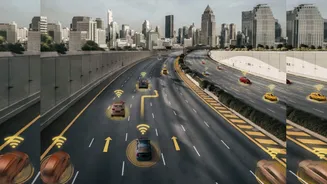
At its heart, the new initiative is about Vehicle-to-Vehicle (V2V) communication. Think of it as a constant, local conversation between cars. Using a dedicated, license-free radio frequency, vehicles will continuously broadcast basic data: their speed,
position, direction, and braking status. This is part of a broader ecosystem called Vehicle-to-Everything (V2X), which allows vehicles to also communicate with infrastructure like traffic lights (V2I), pedestrians (V2P), and the network (V2N). Unlike systems that rely on cameras or radar, V2V can 'see' around corners and through other vehicles, offering warnings about dangers beyond the driver's line of sight. For example, it can alert a driver to a vehicle braking hard several cars ahead, or to a car approaching a blind intersection.
The Driving Force: A Push for Safer Roads
The primary motivation behind this mandate is to tackle India's severe road safety problem. With hundreds of thousands of fatalities and accidents reported annually, the government is turning to technology for solutions. Many accidents are attributed to delayed driver reactions or poor visibility in conditions like fog. V2V technology directly addresses this by giving drivers crucial extra seconds to react. In early August 2026, the Ministry of Road Transport and Highways (MoRTH) issued a draft notification proposing that V2V systems become mandatory. The plan aims to significantly reduce collisions and improve overall traffic management, aligning with India's goal to cut road fatalities.
Decoding the New Rulebook: AIS-230
For this system to work, all vehicles must speak the same language. This is where connected-vehicle standards come in. The cornerstone of the new policy is the Automotive Industry Standard (AIS) 230. This standard defines the minimum technical, performance, and cybersecurity requirements for the V2V systems. It ensures that the on-board units in all vehicles, regardless of the manufacturer, can communicate seamlessly. The standard specifies the use of Cellular V2X (C-V2X) technology operating in the recently de-licensed 5.9 GHz frequency band. This is a crucial step that builds on previous standards like AIS-140, which mandated GPS tracking and panic buttons in public transport to create an Intelligent Transport System (ITS).
A Phased Rollout Plan
The government is proposing a two-stage implementation. Starting from October 1, 2027, any new vehicle that is voluntarily fitted with a V2V system must comply with the AIS-230 standard. Then, from October 1, 2028, it will become mandatory for all newly manufactured vehicles across Categories L (two/three-wheelers), M (passenger vehicles), and N (goods vehicles) to be equipped with AIS-230 compliant V2V systems. This phased approach gives carmakers, component suppliers, and the broader industry time to adapt to the new technological requirements.
Challenges on the Road Ahead
While the vision is compelling, the path to a fully connected vehicle ecosystem has hurdles. A major concern is cost. The addition of V2V hardware will increase the price of new vehicles, which could be a significant factor in India's price-sensitive market. Another critical challenge is cybersecurity. Ensuring that these communication channels are secure from hacking or malicious fake alerts is paramount to building trust in the system. Finally, there is the issue of mixed traffic. For the system to be truly effective, a critical mass of vehicles on the road must be equipped with the technology. During the transition period, 'talking' cars will have to share the road with a majority of 'silent' ones, which will limit the immediate safety benefits.