




The Celebrity Fitness Inspiration
In a video shared by her trainer, Kriti Sanon is seen performing a demanding hanging core challenge. While suspended from an overhead bar, she rapidly kicks a stability ball held in front of her, a move that requires significant core strength, grip, and coordination.
Another trainer is also seen providing support at her waist. It's the kind of high-level-fitness post that makes you want to hit the gym. However, exercises performed by celebrities with professional supervision often fall into the advanced category. The real takeaway isn’t to copy it exactly, but to use it as inspiration to build functional strength safely and progressively. This particular exercise is a variation of a hanging flutter kick, an already difficult move made more complex by the addition of the ball as a target.
Deconstructing the Core Challenge
The exercise Sanon performs is a compound movement that works multiple muscle groups at once. The primary target is the core, including the deep abdominal muscles that are crucial for stability. Simply hanging from a bar engages the grip, shoulders, and lats. Adding the rapid leg kicks intensely works the hip flexors and lower abs. The challenge, and the reason for the trainer's support, is to perform the kicks without letting the body swing, which requires immense core control to prevent momentum from taking over. The stability ball adds an element of coordination and timing, forcing the body to react and control movement in multiple planes.
Why You Shouldn't Skip the Basics
Attempting an advanced exercise like this without the foundational strength can lead to improper form, strain, or injury. Before trying complex stability ball moves, it’s vital to master the fundamentals. A full stability ball pike, for example, is considered an advanced exercise that requires excellent shoulder stability and core strength. Fitness experts recommend that beginners start with more basic movements to build the necessary control and muscle engagement. The unstable nature of the ball is its greatest benefit, as it forces your core to work harder to maintain balance, but it's also what makes proper form so critical.
Foundation First: Build Your Strength
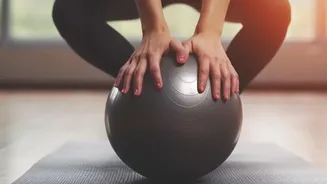
To work towards advanced stability ball exercises, focus on building a strong base. Start with static holds like a standard plank on the floor, then progress to a plank with your shins or forearms on a stability ball. This teaches you to engage your core on an unstable surface. From there, you can introduce movement. The stability ball knee tuck is an excellent precursor. In a plank position with your shins on the ball, you bend your knees and draw them towards your chest, rolling the ball forward before extending back to the start. This builds core control with less strain than a full pike.
At-Home Modifications for a Stronger Core
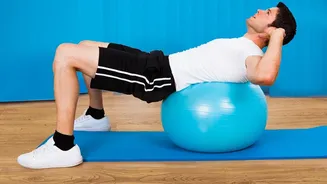
Once you feel comfortable with the basics, you can try scaled versions of more advanced moves. Instead of a full stability ball pike, try a partial pike by lifting your hips only halfway before returning to the plank position. This helps you get used to the movement pattern. Another great at-home exercise is the stability ball rollout. Kneeling on the floor, place your hands or forearms on the ball and slowly roll it forward, extending your body while keeping your core tight, then roll back. For a crunch variation, lie with your back on the ball, which allows for a greater range of motion than a floor crunch and engages more stabilizer muscles.
The Payoff: Benefits of Ball Training
Incorporating a stability ball into your routine, regardless of the exercise, offers numerous benefits. It enhances core strength, which is the foundation for almost every movement you make. It also improves balance, posture, and body awareness (proprioception). Regularly training on an unstable surface strengthens the deep stabilizing muscles around your spine and pelvis, which can help in preventing injuries, particularly in the lower back. Furthermore, using the ball can increase flexibility and range of motion, as it can be used for effective stretching before and after a workout.