





The Scars on Pluto's Heart
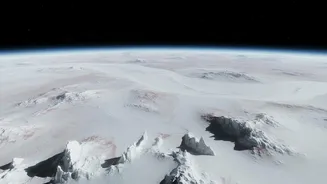
When the New Horizons spacecraft flew past Pluto in 2015, it sent back images that transformed our view of the dwarf planet. The most iconic feature was a massive, heart-shaped glacier named Tombaugh Regio. The western lobe of this heart, a vast basin
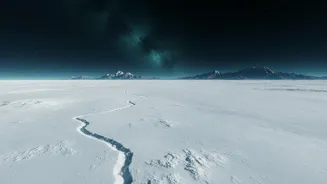
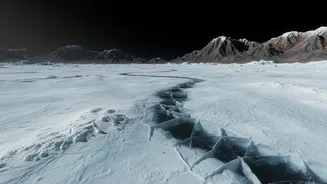
called Sputnik Planitia, is not a smooth, featureless plain. Instead, its surface is covered in enormous cracks and fissures, some stretching for hundreds of kilometres. These extensive fault systems suggested that Pluto's crust had been stretched and broken at some point in its past. Scientists were left with a compelling puzzle: what force could be powerful enough to scar the face of this distant, frozen world? The answer, according to new research, may lie deep beneath the ice.
An Ocean Freezing in Slow Motion
Several scientific teams now believe these cracks are compelling evidence of a subsurface ocean. The leading theory suggests that beneath Pluto's thick shell of water ice, there is a vast layer of liquid water, possibly mixed with ammonia which would act as a natural antifreeze. As this hidden ocean slowly freezes over millions of years, it expands. Water is one of the few substances that becomes less dense when it freezes, meaning ice takes up more space than the liquid it formed from. On a planetary scale, this expansion would exert immense pressure on the overlying ice crust, causing it to stretch, crack, and create the exact kind of extensive fault lines that New Horizons observed.
A Tale of a Wandering Planet
The story gets even more intriguing. Scientists noted that Sputnik Planitia is suspiciously close to the tidal axis it shares with its large moon, Charon. One study proposes that the basin was formed by a giant impact and subsequently filled with dense nitrogen ice. This created a massive positive mass anomaly—a huge, heavy spot on the planet's surface. Over millions of years, Pluto would have reoriented itself, like a top with a piece of gum stuck to it, to move this extra weight toward the equator. This process, known as true polar wander, would have generated enormous stress on the planet's crust. Computer simulations show that this reorientation could only create the observed fracture patterns if a liquid ocean layer existed beneath the crust, allowing the ice shell to slip and slide over it.
Not Just Water, But Nitrogen Too
While a subsurface water ocean explains the large-scale tectonics, more recent analysis from August 2026 points to another kind of liquid on Pluto. Researchers studying high-resolution images of the northern edge of Sputnik Planitia identified dark features that look remarkably like areas on Earth's glaciers that have been wetted by liquid. Given Pluto's frigid temperatures, this liquid is almost certainly not water. Instead, scientists led by Alan Stern of the Southwest Research Institute propose that it is liquid nitrogen. They suggest that nitrogen ice at the base of the massive glacier can melt under pressure and well up to the surface through conduits, briefly flowing before it freezes again. This is the first evidence of recently flowing liquid on Pluto's surface.
Redefining a 'Living' World
The mounting evidence for a subsurface ocean completely changes our perception of Pluto. It shifts it from a static ball of ice and rock to a geologically active world with a hidden, dynamic interior. While this ocean is likely a frigid, ammonia-rich slush rather than a welcoming sea, the presence of liquid water is a key ingredient for life as we know it. It raises profound questions about what makes a world potentially habitable. If a small, distant body like Pluto can retain enough internal heat from its formation and radioactive decay to keep water liquid, it means countless other icy bodies in the Kuiper Belt and beyond could also host hidden oceans. This discovery dramatically expands the potential number of habitable environments in our solar system.