




The Fading Heartbeat of a Distant Explorer
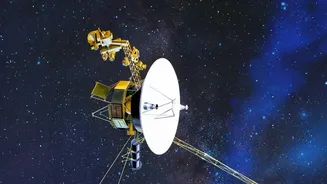
Launched in 1977, Voyager 2 and its twin, Voyager 1, are powered by a remarkable piece of technology: the Radioisotope Thermoelectric Generator (RTG). Unlike solar panels, which would be useless in the dark depths of outer space, RTGs generate electricity
from the heat produced by the natural decay of plutonium-238. At launch, Voyager 2's three RTGs supplied about 470 watts of power, enough to run its suite of scientific instruments. However, this power source has a finite lifespan. The plutonium's decay means the generator's output decreases every year. For Voyager 2, this loss amounts to about four watts annually, a small but relentless decline that forces its engineers into a constant battle against time.
A High-Stakes Game of Kilometres and Watts
For decades, the gradual power loss didn't significantly impact the mission. Engineers compensated by switching off non-essential systems and heaters, especially after the probe completed its historic flybys of Jupiter, Saturn, Uranus, and Neptune. But as Voyager 2 ventured beyond our solar system into interstellar space, the power margins have become, as NASA officials described, "razor thin." The team has had to make increasingly difficult choices, culminating in shutting down science instruments one by one to conserve every possible watt. In September 2024, the plasma science instrument—which was crucial in confirming Voyager 2 had left the Sun's protective bubble, the heliosphere—was powered down. This was followed by the deactivation of the low-energy charged particle instrument in March 2025.
The 'Big Bang' and Other Clever Tricks
Facing the prospect of shutting down another instrument in 2026, the engineering team at NASA's Jet Propulsion Laboratory devised a risky but ingenious plan. Nicknamed the "Big Bang," the procedure involved simultaneously swapping out a group of power-consuming devices for lower-power alternatives, all while ensuring the nearly 50-year-old spacecraft remained warm enough to operate in the frigid interstellar environment. This delicate manoeuvre, performed successfully across billions of kilometres, freed up just enough energy to keep the remaining instruments running. This followed another clever strategy from 2023, where engineers began tapping into a small reservoir of backup power originally set aside for a voltage-regulating safety mechanism, a move that postponed the first instrument shutdown.
The Science That Remains
Thanks to these power-saving efforts, Voyager 2 continues to conduct valuable science with its three remaining operational instruments. The Magnetometer (MAG) measures the magnetic fields of deep space, the Plasma Wave Subsystem (PWS) detects waves in the interstellar plasma, and the Cosmic Ray Subsystem (CRS) studies energetic particles from beyond our solar system. This data is invaluable because Voyager 1 and 2 are the only spacecraft ever to make direct measurements from interstellar space, providing humanity with its first real taste of the environment between the stars. Each piece of data returned becomes more precious the farther the probe travels. The recent "Big Bang" manoeuvre is expected to keep these three instruments operating for at least one additional year.
The Long Goodbye
Despite the team's incredible ingenuity, Voyager 2 cannot last forever. The power decline is irreversible, and more instruments will eventually have to be turned off. Projections suggest that science operations may wind down in the late 2020s or early 2030s, though NASA hopes to maintain contact and receive basic engineering data until around 2036, if the power holds out. Even after it goes silent, Voyager 2's journey will continue. It will drift through the Milky Way for millions of years, a silent ambassador carrying its Golden Record—a message from Earth to the cosmos. The mission's legacy is not just the groundbreaking science it delivered, but also the story of human perseverance and the relentless drive to explore just a little bit farther.