







The Audacious Goal: Hacking Sight
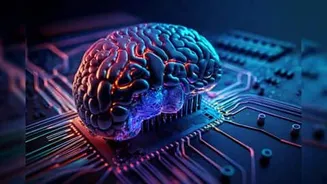
The project, dubbed 'Blindsight', aims to use a brain-computer interface (BCI) to restore vision. The system would use an external camera to capture the world, with software translating that visual data into patterns of electrical stimulation. These signals
are then sent to an array of tiny electrodes implanted in the brain’s visual cortex. The goal is to create the perception of light and shapes, known as phosphenes, effectively bypassing the eyes and optic nerve entirely. Musk has claimed this could work even for people who have been blind from birth. While the company's first human trials have focused on allowing paralysed individuals to control computers, this pivot to sensory restoration represents a massive new ambition. The initial results, as Musk himself has admitted, are expected to be low-resolution, like early video game graphics.
The Safety Dilemma
Before any vision is restored, surgeons must perform invasive brain surgery to place the device. This procedure alone carries significant risks, including infection, bleeding, and potential damage to delicate brain tissue. Beyond the surgery, the brain has a powerful defense mechanism against foreign objects. The immune system’s natural response is to identify the implant as an invader and attempt to wall it off. This process, known as glial scarring or encapsulation, involves building up scar tissue around the electrodes. This biological barrier can degrade or block the very signals the device needs to send and receive, rendering it less effective or even useless over time. There's also the physical risk of the device itself failing or migrating within the brain, which could cause neurological damage.
The Resolution Problem
Even if the implant is safe, the quality of the vision it produces is a fundamental hurdle. The sight generated by a cortical implant is not a clear picture; it is an interpretation of light patterns. Users perceive dots of light, or phosphenes, which can form shapes and outlines. While Musk has compared the initial quality to “early Nintendo graphics,” experts caution that achieving even this is incredibly complex. The human visual cortex doesn't process information like a simple computer screen. Each neuron responds to specific patterns and locations, meaning that just adding more electrodes—more 'pixels'—does not guarantee a clearer image. Research suggests that even with a high-resolution implant, the resulting perception can be blurry and lack detail because of how the brain is stimulated. Creating a stable, useful, and high-fidelity image inside someone's mind remains one of the biggest challenges in neuroscience.
The Longevity Question
Perhaps the most significant long-term obstacle is durability. Brain implants have a history of failing over time. The constant, warm, and corrosive environment of the human body is tough on electronics. The materials of the electrodes can degrade, crack, or corrode. This, combined with the aforementioned scar tissue formation, contributes to a phenomenon known as “signal degradation” or “recording instability,” where the implant’s performance worsens over months or years. This isn't just a technical problem; it’s a human one. The cautionary tale of Second Sight, a company that developed a bionic eye called Argus II, looms large. When the company faced financial trouble and shifted focus, it stopped supporting the implants, leaving hundreds of patients with obsolete, and in some cases non-functional, technology embedded in their bodies. For any new device to be successful, it must prove it can last for decades, not just a few years.