


Meet the Peculiar Pair
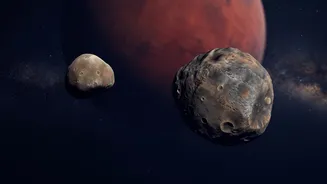
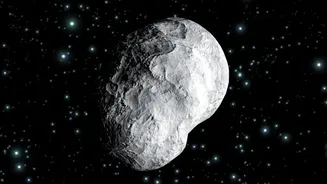
Phobos and Deimos are oddballs. Unlike Earth’s large, spherical Moon, they are small, potato-shaped rocks. Phobos, the larger of the two, is only about 22 kilometres across, while Deimos is even smaller. They are dark, heavily cratered, and look a lot
like a specific type of asteroid common in our solar system. This appearance led to the first major theory about their origin. Phobos is also in a precarious situation: it orbits incredibly close to Mars and is slowly being pulled in, expected to either crash into the planet or be torn apart to form a ring in about 50 million years. Deimos, meanwhile, is slowly drifting away.
Theory 1: The Captured Asteroids
For a long time, the leading hypothesis was that Phobos and Deimos were once asteroids minding their own business in the asteroid belt. The idea is that they wandered too close to Mars and were captured by its gravitational pull. This 'capture hypothesis' makes sense when you look at them; their composition seems very similar to carbonaceous C-type or D-type asteroids. However, there’s a major flaw in this theory. When a planet captures an object, the object usually ends up in a strange, elliptical, and tilted orbit. Phobos and Deimos, however, have very neat, nearly circular orbits that are almost perfectly aligned with Mars's equator. It’s a celestial hole-in-one that’s incredibly difficult to explain with the capture theory alone.
Theory 2: The Giant Impact
The second major theory proposes a much more violent beginning. Similar to how Earth's Moon is thought to have formed, this idea suggests that a huge object—perhaps a protoplanet or a massive asteroid—slammed into a young Mars billions of years ago. The cataclysmic collision would have blasted a massive cloud of Martian rock and debris into orbit. Over time, this debris would have clumped together to form Phobos and Deimos. This 'giant impact hypothesis' does a much better job of explaining their tidy, circular, equatorial orbits. But this theory isn't perfect, either. If the moons were made from Martian crust, their composition should be a close match to Mars. However, initial observations suggest they look more like asteroids.
A Cosmic Puzzle With No Easy Answer
So, we have a cosmic contradiction. The moons' appearance and composition point towards the captured asteroid theory, while their orbits strongly support the giant impact theory. This is the central puzzle that has left scientists stumped for decades. Each piece of evidence seems to invalidate the other leading hypothesis. Some scientists have proposed hybrid theories, such as an impact creating a large moon that then broke apart, or a passing asteroid being torn apart by Mars's gravity to form a ring from which the moons later formed. But without more direct evidence, these ideas remain speculative.
A Mission to Bring Back Answers
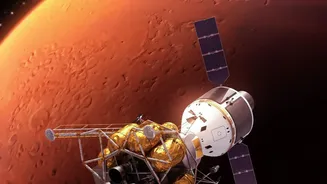
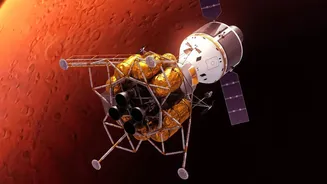
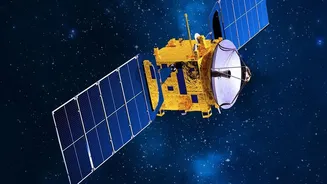
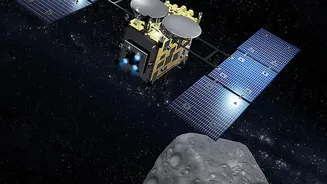
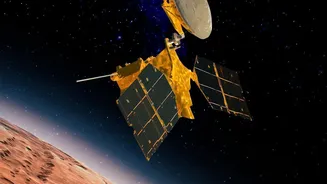
To solve this mystery once and for all, the Japan Aerospace Exploration Agency (JAXA), in partnership with NASA and other international space agencies, has launched the Martian Moons eXploration (MMX) mission. The spacecraft, which launched in the autumn of 2026, will travel to the Martian system to study both moons up close. Its primary goal is to land on Phobos, collect at least 10 grams of surface material, and return it to Earth for analysis in 2031. By studying an actual sample in a lab, scientists can finally determine its true composition. If the sample is made of the same stuff as Mars, the giant impact theory wins. If it’s a match for meteorites from the asteroid belt, then scientists will have to figure out how the capture theory can work despite the orbital oddities. The sample might even contain traces of Martian rock blasted onto Phobos by ancient impacts, giving us a bonus sample of Mars itself.