


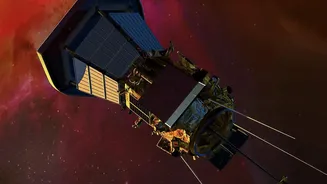

What is PRIMA?
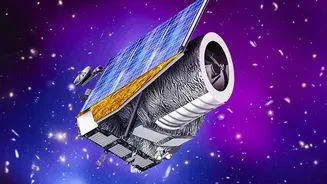
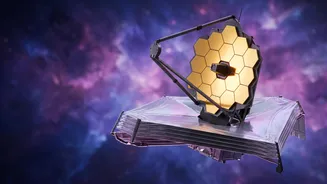
PRIMA, short for the PRobe far-Infrared Mission for Astrophysics, is the first in a new class of NASA missions called Probe Explorers. It is a sophisticated space telescope featuring a 1.8-metre primary mirror that will be cryogenically cooled to just
a few degrees above absolute zero. This extreme cold is crucial, as it reduces the telescope's own heat, which would otherwise blind its sensitive instruments. Managed by NASA's Jet Propulsion Laboratory, PRIMA is a significant international collaboration involving partners from Canada, France, Germany, Japan, South Korea, and the United Kingdom. Its primary goal is to observe the universe in far-infrared light, a range of wavelengths that is largely invisible to other telescopes like the James Webb Space Telescope (JWST) and opens a new window onto the cosmos.
Answering Fundamental Questions
The mission's focus on "real-world use" translates to tackling some of the most profound questions in science. PRIMA’s science goals are divided into three main themes: exploring the evolution of galaxies, understanding the origins of planets and their atmospheres, and tracking the creation of cosmic dust and heavy elements over time. Nicky Fox, an associate administrator at NASA, described the mission as "humanity's next window into the deep universe," which will help us better understand everything from black holes to how water arrived on Earth. By observing in the far-infrared, PRIMA can peer through dense clouds of cosmic dust that obscure the view of other observatories, allowing it to see the very processes of star and planet formation in action.
The Technology Driving the Mission
To achieve its ambitious goals, PRIMA will carry two main instruments: the Far-Infrared Enhanced Survey Spectrometer (FIRESS) and the PRIMA Imager (PRIMAger). FIRESS will be able to analyze the chemical composition of distant objects with incredible sensitivity, while PRIMAger will capture detailed images. This technology represents a huge leap forward from previous far-infrared missions like the Herschel Space Observatory, with PRIMA expected to be orders of magnitude more sensitive. This advancement is the result of decades of research into new detector technologies pioneered by institutions like Caltech and JPL. This allows PRIMA to bridge the observational gap between missions like JWST, which sees in near- and mid-infrared, and ground-based radio telescopes like ALMA.
The Long Road to 2033
A 2033 launch may seem distant, but it reflects the complex development cycle of such a groundbreaking mission. NASA has now approved PRIMA to move into Phase B, which involves finalizing the preliminary design and maturing the necessary technology. This phase is critical for ensuring the mission can be completed within its projected $1.2 billion cost cap and on schedule. Over the next few years, teams of engineers and scientists will work to turn the conceptual designs into flight-ready hardware. This includes instrument delivery from international partners, which is expected around 2029. Following a series of rigorous reviews, if all goes to plan, the mission will proceed to full-scale construction and eventually prepare for its five-year journey of discovery.