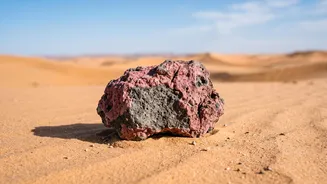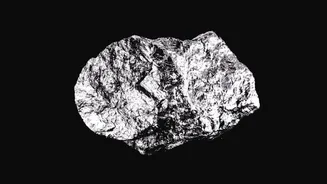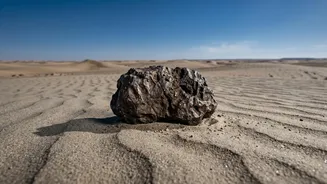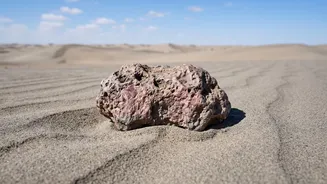




A rose-coloured rock found in the Sahara Desert is offering an unprecedented look into the birth of Mars. This ancient messenger, Teghaza 001, is one of the oldest Martian meteorites ever discovered, and it’s changing how we see the Red Planet's fiery
youth.
A 'Rosetta Stone' from the Sahara
In 2022, meteorite hunters in Mali discovered an 800-gram rock that looked unusual. It was named Teghaza 001 after the nearby salt plain. Initially, scientists weren't sure of its origin, but detailed analysis soon revealed a stunning truth: this was no ordinary space rock. It was a piece of Mars, blasted off the planet by an asteroid impact millions of years ago before eventually landing on Earth. What makes Teghaza 001 truly special is its incredible age. Scientists using advanced dating techniques determined the rock formed more than 4.1 billion years ago, making it a rare relic from the infancy of our solar system. One researcher even called it a 'Rosetta Stone for Mars' because it helps decipher a period of Martian history we've never had direct access to before.
An Unadulterated Piece of Martian Crust
Most of the 400-plus Martian meteorites found on Earth are much younger, typically less than 2.4 billion years old. This has long puzzled scientists, as much of Mars's surface is known to be far older. Teghaza 001 helps fill that gap. Unlike other meteorites that are often a jumble of different rock fragments, Teghaza 001 is what scientists call an 'unadulterated' igneous rock. This means it's a pure, single piece that cooled slowly from magma deep within the Martian crust. Its unique mix of igneous minerals tells a complex story, preserving the chemical signature of its formation from a magma ocean and subsequent alteration by subsurface water.
Rewriting the Story of Volcanic Mars
The analysis of Teghaza 001 is challenging previous assumptions about how Mars's crust evolved. For a long time, the Red Planet was thought to have a relatively simple volcanic history compared to the dynamic tectonic activity of Earth. This rock suggests a more complex past. The specific mineral composition points to a multi-stage process, where the initial crust formed from cooling magma was later altered by hot, mineral-rich water circulating beneath the surface. This interaction with water happened at least 4.1 billion years ago, providing some of the strongest evidence yet for a warmer, wetter early Mars. The rock's chemistry is a match for the planet's heavily cratered southern highlands, a region NASA's Mars Reconnaissance Orbiter has identified as one of the oldest on the surface.
Clues to Planetary Formation and Life
Studying Teghaza 001 doesn't just tell us about Mars; it holds lessons for Earth, too. Because of Earth's active geology, with its churning tectonic plates, almost none of our planet's original primordial crust remains. Mars, being geologically less active, acts as a time capsule. By understanding how its crust formed and evolved, scientists can refine their models of how all rocky planets, including our own, come into being. Furthermore, the evidence of sustained interaction between rock and liquid water billions of years ago has profound implications for the search for life. Such environments could have provided the energy and chemical ingredients necessary to support microbial organisms, raising fascinating questions about the planet's potential habitability in its distant past.