




The Old Assumption: More Heat, More Snow
The logic seemed simple: a warmer atmosphere holds more moisture. Over the vast, frigid expanse of Antarctica, this increased moisture was expected to fall as snow. Climate models largely predicted that this accumulating snow would add mass to the continent's
colossal ice sheets, partially offsetting the ice being lost from melting glaciers in a warming world. This process, known as surface mass balance, is a critical variable in calculating future sea level rise. The East Antarctic Ice Sheet, in particular, was seen as a relatively stable giant, a place where this added snowfall might make a significant, positive difference.
A Surprising Twist from the Tropics
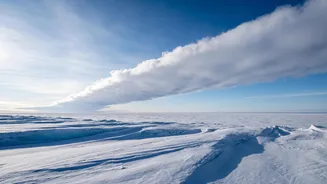
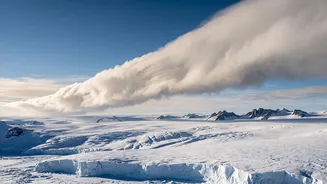
However, a recent study published in the journal Nature has uncovered a fascinating and unexpected driver of Antarctic weather. Researchers found that between 2021 and 2023, East Antarctica experienced a period of exceptionally high snowfall, leading to a temporary gain of approximately 695 billion tons of ice. This wasn't a simple case of global warming causing more snow. Instead, the scientists traced the cause thousands of kilometres away to an unusually warm patch of the tropical ocean where the western Pacific meets the eastern Indian Ocean. This sustained ocean warmth triggered large-scale atmospheric waves that travelled south, altering circulation patterns and funnelling huge amounts of moisture directly toward East Antarctica.
Why East Antarctica is the 'Sleeping Giant'
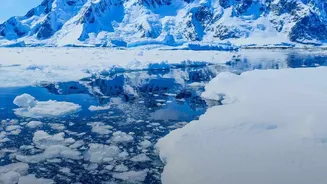
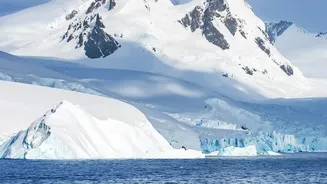
Antarctica is not a single, uniform block of ice. It is broadly divided into two parts: West Antarctica and East Antarctica. Much of the recent, alarming news about melting has focused on the West Antarctic Ice Sheet, which is considered less stable because large parts of it rest on bedrock below sea level. In contrast, the East Antarctic Ice Sheet is the largest on Earth, holding enough ice to raise global sea levels by over 50 metres. It rests mostly on high-altitude ground and has long been considered the planet's 'sleeping giant'—vast, cold, and relatively stable. Any unexpected change in this region, whether a gain or a loss, has massive implications for the planet's future.
A Temporary Gain, Not a Reversal
While the news of a 695-billion-ton ice gain sounds like a positive development, researchers are quick to caution that this does not reverse the long-term trend. The Antarctic continent as a whole has been losing ice at an alarming rate for decades. The recent heavy snowfall in the East was a specific, short-term event driven by anomalous conditions in the tropics. It temporarily slowed the continent's overall contribution to sea level rise, but it doesn't change the underlying physics of warming oceans melting glaciers from below. In fact, other research using ice cores to look back over a millennium shows that the continent has experienced centennial-long periods of much lower snowfall than we see today, suggesting that relying on high snowfall to offset melt is a risky assumption.
Rethinking Our Climate Models
This new understanding complicates the picture for scientists trying to predict the future. The findings highlight that current climate models may not fully capture these complex, long-distance connections—or 'teleconnections'—between tropical oceans and polar weather. For a long time, observations and models have shown discrepancies in the Antarctic. Some studies noted that snowfall had not increased over 50 years as models predicted, while others found localized increases. The recent study provides a powerful explanation for some of these massive swings, showing that they can be driven by periodic events far away rather than a steady, linear response to global warming. This means that to accurately project sea level rise, we need a much better grasp of how ocean warming in one part of the world can dramatically impact ice accumulation in another.