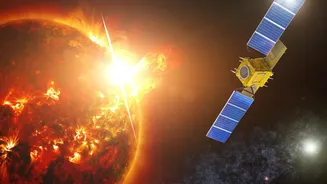


India's Aditya-L1 solar observatory is changing how we see the Sun. A recent study reveals that solar eruptions are not the perfect bubbles we imagined, a discovery that could reshape our understanding of space weather and its impact on Earth.
A New Look at Solar Eruptions
For decades,
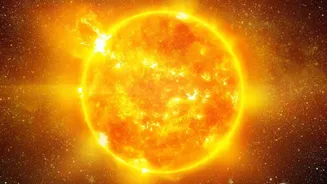
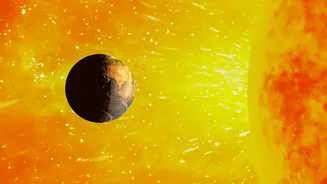
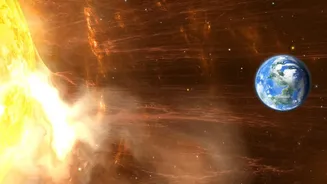
scientists have studied the Sun's violent outbursts, known as Coronal Mass Ejections (CMEs). These are colossal clouds of charged particles and magnetic fields that explode from the Sun's atmosphere. It was often assumed they expanded uniformly, like a perfectly round balloon. However, new research powered by India's Aditya-L1 mission challenges this idea. A study by scientists at the Indian Institute of Astrophysics (IIA) has shown that these eruptions can be lopsided, expanding unevenly and developing an irregular shape as they travel through space. This seemingly small detail has big implications for predicting their journey and potential arrival at Earth.
The Power of Three Dimensions
The breakthrough comes from a powerful combination of tools. Scientists used observations from Aditya-L1’s primary instrument, the Visible Emission Line Coronagraph (VELC), alongside images from NASA’s Solar Dynamics Observatory. While traditional coronagraphs can track an eruption's movement across the sky, they struggle to measure its speed towards or away from us. This is where VELC provides a crucial third dimension. By analysing shifts in the wavelength of light—a phenomenon known as the Doppler effect—VELC can detect whether solar material is moving towards or away from its sensors. This data allowed the IIA team to build a comprehensive 3D model of a CME that occurred on August 5, 2024.
Challenging the 'Bubble' Model
The researchers created a computer model to simulate the eruption. When they programmed the model to expand symmetrically—like a bubble—it failed to match what Aditya-L1 had actually observed. However, a different model, one where the eruption was tilted and expanded unevenly towards its sides, was a near-perfect match for the real-world data. This confirmed that the eruption was not uniform. The discovery of this asymmetric expansion is significant because the shape of a CME can influence how it travels through space, affecting its speed and trajectory.
Why This Matters for Space Weather
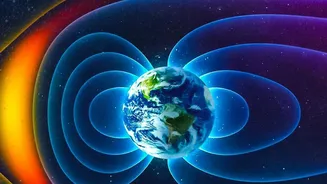
Understanding CMEs is not just an academic exercise. When these eruptions are aimed at Earth, they can wreak havoc on our technology. They can disrupt satellites, scramble GPS and communication networks, and in severe cases, even induce currents in power grids on the ground. Improving 'space weather' forecasts is therefore a critical priority. By providing a more accurate picture of how CMEs behave in their earliest stages, Aditya-L1's findings can help scientists create more reliable models to predict their arrival time and potential impact. This gives satellite operators and grid managers more time to take protective measures.
Aditya_L1's Unique Vantage Point
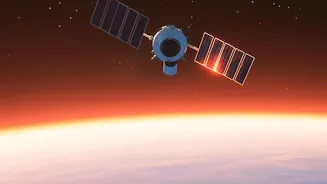
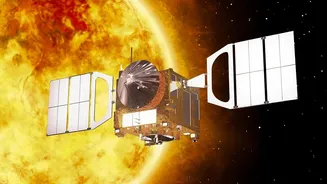
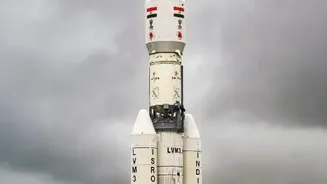
Launched in September 2023, the Aditya_L1 observatory is positioned at Lagrange Point 1 (L1), about 1.5 million kilometres from Earth. From this strategic location, it has an uninterrupted view of the Sun, free from the eclipses or occultations it would experience in Earth's orbit. This continuous observation is what makes long_term studies of solar phenomena possible. The latest finding demonstrates the unique capability of the VELC instrument, designed and built in India, to add a crucial layer of data to solar physics. By combining its spectroscopic measurements with imaging from other observatories, Aditya_L1 can help reconstruct the 3D evolution of solar events from a single vantage point—a powerful new tool in our quest to understand our star.