



The Arctic's Cloudy Mystery
For years, scientists have grappled with a complex question in the Arctic: what is the deal with the clouds? Unlike clouds in other parts of the world, Arctic clouds can have a dual effect. They can reflect sunlight back into space, which has a cooling
effect, or they can trap heat radiating from the Earth's surface, acting like a blanket and causing warming. Which role they play depends on many factors, including the season and the tiny particles around which they form. Understanding this delicate balance is one of the biggest challenges in climate science, as it has massive implications for the speed of global warming. The more accurately we can model these clouds, the better our climate projections will be.
A Surprising New Source of Cloud Seeds
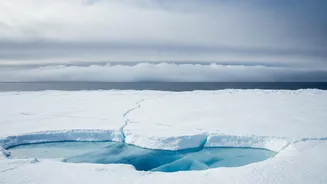
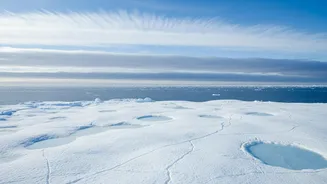
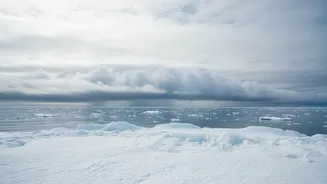
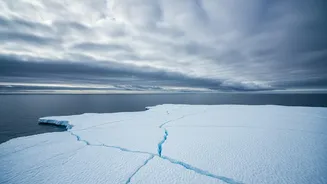
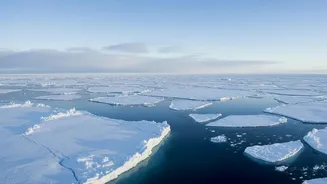
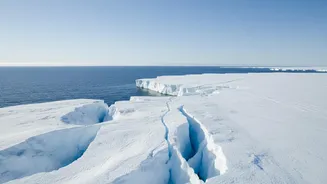
A new study published in Nature Geoscience has uncovered a fascinating and previously unknown natural process. An international team of scientists found that where Arctic sea ice meets the open ocean, a powerful cloud-seeding mechanism kicks in. It turns out that as the ice melts, it exposes a highly productive zone at the ice edge. Here, sunlight interacts with marine life like algae, causing a release of a chemical cocktail of iodine, sulphur, and organic compounds into the air. These chemicals react in the atmosphere to create brand-new particles. These aren't just any particles; they are what scientists call 'cloud condensation nuclei'—the very seeds that water vapour needs to form cloud droplets.
An Explosion of Particles
The impact of this process is dramatic. During an expedition near Greenland, researchers observed the number of these cloud-seeding particles increase fifty-fold in a single day. In one instance, the concentration jumped from around 50 particles per cubic centimetre of air to roughly 1,500. This finding provides the first real-world evidence for a chemical process that had previously only been demonstrated in lab experiments at CERN. This discovery helps explain a key part of the puzzle. The Arctic air is often very clean, with few of the dust or industrial soot particles that typically form clouds elsewhere. This natural particle factory at the ice's edge provides a powerful local source, potentially changing cloud cover significantly.
A Complex Feedback Loop
This discovery adds another layer to the intricate feedback loops governing the Arctic. The basic cycle is that a warming atmosphere melts sea ice. This study now shows that the melting ice helps create more particles, which in turn leads to more clouds. But what happens next is the multi-billion dollar question. Will these new clouds be the thin, low-lying type that trap heat and accelerate further melting? Or will they be thicker, brighter clouds that reflect sunlight and slow the warming down? The answer is not yet clear, but this new data gives climate modelers a vital new variable to include in their projections, potentially making them much more accurate.
Why the Arctic Matters to India
It can be easy to think that 'what happens in the Arctic, stays in the Arctic,' but that view is dangerously outdated. The Arctic is essentially the planet's air conditioner, and its rapid warming has global consequences. Changes in the temperature difference between the pole and the tropics can alter the path of the jet stream, the high-altitude air current that steers weather systems around the Northern Hemisphere. A wavier, slower jet stream can lead to more persistent and extreme weather events—like prolonged heatwaves, droughts, and floods—in places far from the Arctic, including having potential influences on atmospheric patterns that affect the Indian monsoon. The stability of our own weather patterns is linked to the stability of the Arctic.