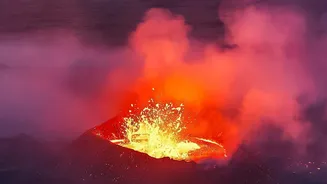






Hunga Tonga-Hunga Ha'apai, Tonga (2022)
The eruption of the Hunga Tonga-Hunga Ha'apai submarine volcano is officially the largest explosive event of the 21st century so far. The blast in January 2022 was an unparalleled spectacle of nature's power, hundreds of times stronger than the atomic
bomb dropped on Hiroshima. It produced a sonic boom heard as far away as Alaska and sent an atmospheric pressure wave circling the globe multiple times. Unlike other major eruptions that cool the planet by ejecting sunlight-blocking sulfur dioxide, this underwater explosion blasted an enormous quantity of water vapor—an estimated 146 million tons—into the stratosphere. This massive injection of water, a greenhouse gas, is expected to have a temporary warming effect on the Earth's surface. The eruption also triggered a devastating tsunami that caused casualties and widespread damage in Tonga and was detected across the Pacific Ocean.
Eyjafjallajökull, Iceland (2010)
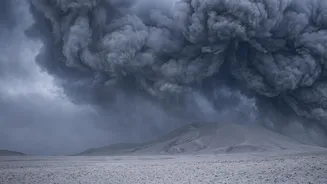
While not the most powerful in terms of explosive force (rated a 4 on the Volcanic Explosivity Index), the 2010 eruption of Iceland's Eyjafjallajökull became a prime example of how a single volcano can cause widespread societal disruption. The eruption occurred beneath a glacier, a combination that created incredibly fine, abrasive ash particles. These particles were then carried by the jet stream directly into some of the world's busiest airspace. Fearing the glass-like ash would destroy jet engines, authorities enacted a sweeping shutdown of European airspace for six days, the largest air traffic disruption since World War II. Over 100,000 flights were cancelled, stranding millions of passengers and costing the airline industry billions. The event was a stark reminder of modern society's vulnerability to geological events, where the economic fallout can far outweigh the eruption's physical footprint.
Mount Merapi, Indonesia (2010)
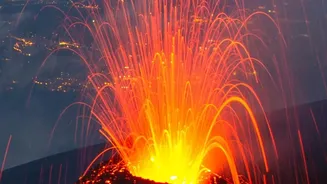
In the same year as Eyjafjallajökull, a far deadlier series of eruptions began at Mount Merapi, one of Indonesia's most active and dangerous volcanoes. Starting in late October, the volcano unleashed a torrent of pyroclastic flows—fast-moving currents of hot gas and volcanic matter—down its densely populated slopes. These flows are one of the greatest hazards of volcanism, and at Merapi, they proved devastating. The eruptions ultimately claimed 386 lives and forced the evacuation of over 350,000 people. It was the volcano's largest eruption since the 1870s. The event highlighted the immense challenge of managing risk in regions where millions live in the shadow of active volcanoes, even with advanced monitoring and timely evacuation warnings.
Puyehue-Cordón Caulle, Chile (2011)
The eruption of Chile's Puyehue-Cordón Caulle volcanic complex in June 2011 was notable for the sheer volume of material it ejected and the global journey of its ash cloud. After being dormant for half a century, the volcano roared to life, sending a plume of ash and pumice an estimated 15 kilometers into the atmosphere. The eruption was one of the largest of the century, ejecting around one hundred million tons of ash. Carried by high-altitude winds, the ash cloud circled the entire Southern Hemisphere in about two weeks, causing major flight disruptions in South America, South Africa, Australia, and New Zealand. The event forced the evacuation of several thousand people near the volcano and blanketed nearby towns in a thick layer of ash.