




The 'Ghost Particle' Puzzle
Imagine a particle so small and elusive that trillions of them pass through your body every second without you ever noticing. These are neutrinos, often called 'ghost particles'. They have almost no mass, no electric charge, and they travel at nearly
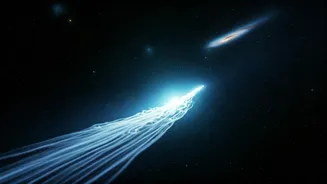
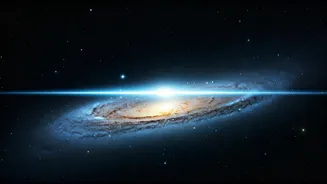
the speed of light. Born from cataclysmic events like exploding stars (supernovae), the hearts of active galaxies, and the nuclear fusion that powers our own Sun, neutrinos are the second most abundant particle in the universe. Because they barely interact with other matter, they travel across billions of light-years in a straight line, carrying pristine information from their violent birthplaces. This unique quality makes them invaluable cosmic messengers, offering a window into processes that are impossible to see with traditional light-based telescopes. However, this same reluctance to interact makes them incredibly difficult to detect.
Building a Telescope for Ghosts
How do you catch a particle that can pass through an entire planet unscathed? The answer is to build a telescope of monumental proportions. The leading experiment in this field is the IceCube Neutrino Observatory, which has turned a cubic kilometre of ultra-pure ice at the South Pole into a massive detector. When a high-energy neutrino, by a slim chance, crashes into an atom in the ice, it creates a cascade of secondary particles that emit a faint blue light called Cherenkov radiation. An array of over 5,000 light sensors buried deep in the ice records these flashes, allowing scientists to reconstruct the neutrino's energy and direction. But IceCube doesn't work alone. This is where the global network of observatories, including those in Hawaii and Chile, comes into play, creating a new field known as multi-messenger astronomy.
A Global Network in Action
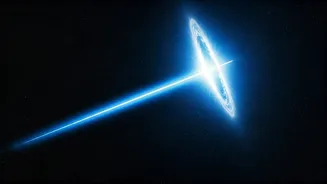
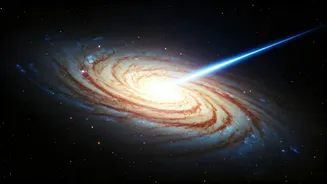
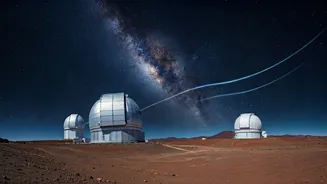
The headline mentions Hawaii and Chile for a crucial reason. When IceCube detects a promising high-energy neutrino, it sends out an alert to observatories around the world within seconds. Telescopes in prime locations, like the Subaru Telescope and others on Maunakea in Hawaii and the newly operational Vera C. Rubin Observatory in Chile, rapidly swing into action to scan the patch of sky the neutrino came from. They search for a corresponding flash of light, gamma-rays, or other signals from a cosmic source. For instance, in 2017, a neutrino alert from IceCube was followed up by telescopes, including some in Hawaii, which pinpointed a flaring blazar—a galaxy with a supermassive black hole at its centre—as the source. More recently, in 2021, telescopes in Hawaii were instrumental in identifying a distant, dusty, star-forming galaxy as the potential origin of another high-energy neutrino.
Unlocking Cosmic Secrets
This coordinated global effort is revolutionising our understanding of the universe. For over a century, scientists have wondered about the origin of high-energy cosmic rays, particles that constantly bombard Earth. By tracing neutrinos back to their sources, like the blazar TXS 0506+056, astronomers have found the first direct evidence of a cosmic-ray accelerator. These findings are helping to solve long-standing mysteries and are revealing new types of cosmic engines. Recent discoveries suggest that not just black holes, but also intensely star-forming galaxies, could be powerful neutrino factories. Each detection helps build a map of the high-energy universe, providing insights into phenomena like supermassive black holes, the birth of heavy elements, and the fundamental laws of physics. Combining data from neutrinos, light, and even gravitational waves is giving us a more complete picture of cosmic events than ever before.