
The Project at a Glance
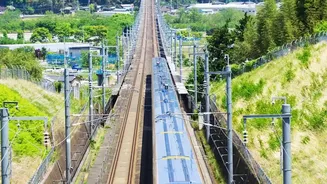
India's first high-speed rail line is officially known as the Mumbai-Ahmedabad High-Speed Rail (MAHSR) Corridor. Spanning approximately 508 kilometres, it will connect Maharashtra's financial capital, Mumbai, with the economic hub of Ahmedabad in Gujarat.
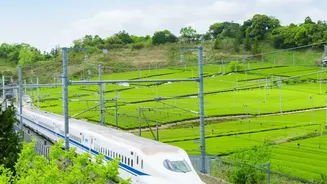
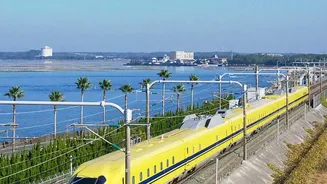
The project is being developed by the National High Speed Rail Corporation Limited (NHSRCL) with significant technical and financial assistance from Japan, using its world-renowned Shinkansen technology. The foundation stone for this landmark project was laid back in September 2017. Its primary goal is to drastically reduce travel time and enhance connectivity between these two major western Indian cities.
How Fast and What's the Route?
The bullet train is designed to operate at a speed of 320 km/h, with a maximum design speed of 350 km/h. This will slash the travel time between Mumbai and Ahmedabad to just under two hours for limited-stop services, a significant reduction from the current six to seven hours by conventional rail. The corridor will feature 12 stations in total: Mumbai (BKC), Thane, Virar, Boisar, Vapi, Bilimora, Surat, Bharuch, Vadodara, Anand/Nadiad, Ahmedabad, and Sabarmati. A notable engineering feat of the project is a 21-km tunnel, which includes India's first undersea rail tunnel near Thane Creek.
Current Status and Timeline
As of September 2026, construction is progressing rapidly. Union Railway Minister Ashwini Vaishnaw has stated that the project is advancing at a strong pace, with the first test coach already prepared. According to recent official statements, the first section of the corridor, between Surat and Bilimora in Gujarat, is targeted to become operational in August 2027. In fact, Railway Minister Ashwini Vaishnaw has indicated that an indigenously manufactured bullet train could begin track testing as early as May or June 2027. While the first service is expected next year, the full 508-km corridor is now projected to be completed by 2030.
What Is the Project Cost?
The project has seen significant cost revisions since its inception. The initial estimate was around ₹1.1 lakh crore when the project was approved in 2017. However, due to various factors including delays in land acquisition and revisions in construction plans, the estimated cost has now escalated to approximately ₹2.1 lakh crore. This revised budget was recently submitted for cabinet approval. The funding for the project is a joint effort, with the Japan International Cooperation Agency (JICA) providing a substantial loan, and the rest being covered by the central government and the state governments of Gujarat and Maharashtra.
Indigenous Manufacturing Push
While the project began with Japanese technology, there is a strong 'Make in India' component. Efforts are underway to develop and manufacture high-speed trainsets within the country. Railway Minister Ashwini Vaishnaw confirmed that the first body frame of an indigenous bullet train has been completed and sent for testing. Companies like BEML have been awarded contracts to design and manufacture prototype high-speed train sets capable of running at 280 kmph. This move is aimed at building domestic capabilities, reducing reliance on imports for future high-speed rail projects, and creating a local manufacturing ecosystem.