



Meet the Celestial Lion
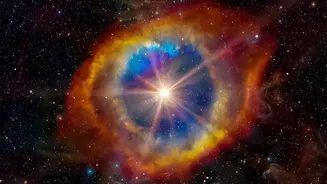
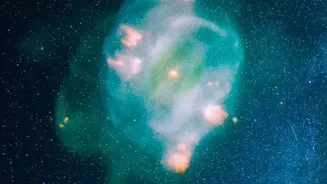
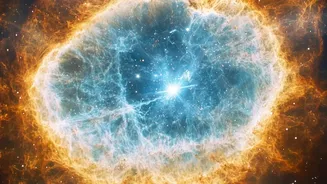
Located about 5,000 light-years away in the constellation Gemini, the celestial object known as NGC 2392 has been nicknamed the Lion Nebula for its uncanny resemblance to a lion's head, complete with a flowing mane. For years, astronomers have studied
this object, but its intricate details remained partially obscured. The structure is a planetary nebula, a slightly misleading name as it has nothing to do with planets. Instead, it is the glowing, expanding shell of gas and dust that was shed by a star similar to our own Sun as it reached the end of its life. The new images from the James Webb Space Telescope (JWST) have given us our most detailed look yet into this cosmic spectacle, capturing a fleeting moment in the life cycle of a star.
The Dying Star at the Center
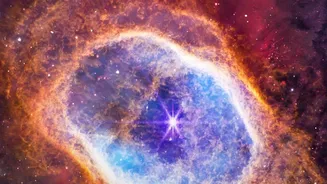
At the heart of the Lion Nebula, appearing like a small button nose, lies the culprit behind its magnificent structure: the remains of the star that created it. This object is a white dwarf, an incredibly hot and dense stellar core left behind after the star exhausted its nuclear fuel and puffed away its outer layers thousands of years ago. This white dwarf is now fiercely radiating energy, blasting the material it previously ejected. This intense radiation is “cooking” the surrounding gas from the inside out, causing it to glow and forming the complex shapes we see. The entire nebula is a direct consequence of this central star’s final, dramatic phases, a vast monument to a star's death.
What Webb's Infrared Eyes Revealed
While previous observatories like the Hubble Space Telescope gave us wonderful views in visible light, the James Webb Space Telescope sees the universe in infrared, allowing it to peer through obscuring layers of cosmic gas and dust. Using its Near-Infrared Camera (NIRCam) and Mid-Infrared Instrument (MIRI), Webb has unveiled the Lion Nebula’s structure with unprecedented clarity. The new portrait highlights features that were previously hazy, showing a cavernous bubble of ionized gas forming the lion's “face,” which is expanding and destroying dust in its path. But Webb also revealed that not all the dust is destroyed. The flowing “mane” is made of surviving filaments and compact clumps of dust that are withstanding the intense radiation, protecting the material that lies behind them.
A Fleeting Cosmic Masterpiece
This detailed new view provides a snapshot of a dynamic and violent process. The nebula as we see it today is not a permanent fixture in the sky. It has taken several thousand years to evolve into its current shape, and it continues to change as the central white dwarf's fierce winds push the gas and dust further into space. Astronomers estimate that the entire structure of the Lion Nebula will completely disperse in about 10,000 years. In cosmic terms, this is a remarkably short period. It means we are witnessing a beautiful, yet temporary, phase in the universe’s grand cycle of stellar life and death. Each image is a postcard from a specific moment in time, capturing the temporary glory of a star's end.