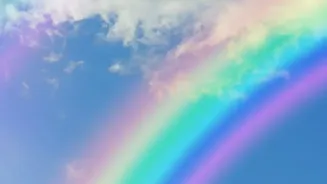






That beautiful arc of colour in the sky after a storm is one of nature’s most iconic sights. But what if that familiar semi-circle was only half the story? In reality, every rainbow is a full circle, and we’re just not high enough to see it.
The Arc We All Know and Love
We learn the
basics from a young age: sunlight and rain are the essential ingredients for a rainbow. When the sun emerges while the air is still filled with water droplets, we know to look to the sky. Facing away from the sun, we often see a multi-coloured arc, with red on the outside and violet on the inside. For most of us, this arc is the complete picture, a temporary and beautiful painting across the clouds. It seems to have a beginning and an end, touching down somewhere on the horizon. This perception, however, is a trick of perspective. The arc we see is only a portion of a much larger, and more complete, spectacle.
How Light Bends and Bounces
To understand the full picture, we need to shrink our focus down to a single raindrop. When a ray of sunlight enters a spherical water droplet, it does three things. First, it bends, or refracts, as it slows down upon entering the denser medium of water. This process splits the white sunlight into its component colours, just like a prism. Next, this separated light reflects off the inside back of the raindrop. Finally, as the light exits the droplet, it refracts again, bending once more before travelling towards an observer's eye. The crucial part is that the light always exits the raindrop at a very specific angle: between 40 and 42 degrees relative to the path of the incoming sunlight.
The Secret of the 42-Degree Angle
This 42-degree angle is the key to everything. Every single one of the millions of raindrops in a shower is reflecting and refracting sunlight in the same way. However, you only see the light from the raindrops that are positioned at that precise 40-42 degree angle from the point opposite the sun, known as the antisolar point. Imagine a cone of light with its tip at your eye, pointing towards your own shadow's head (the antisolar point). The rainbow you see is the circular base of that cone. All the raindrops lying on this circular path are in the perfect position to send their coloured light directly to you. Red, which exits at a slightly larger angle (42 degrees), forms the outer ring, while violet (at 40 degrees) forms the inner one.
Why the Ground Gets in the Way
So, if every rainbow is a circle, why do we only see an arc? The answer is simple: the ground. From our usual vantage point on the surface of the Earth, the horizon cuts off the bottom half of the circle. We can only see the portion of the rainbow that forms above the ground, because there are typically no suspended water droplets between our feet and the horizon. The antisolar point, the very centre of the rainbow's circle, is usually below our horizon. As the sun gets lower in the sky, during sunrise or sunset, the antisolar point rises, allowing us to see a larger, more complete semi-circle. Conversely, if the sun is higher than 42 degrees above the horizon, the centre of the rainbow is so far below the horizon that no arc is visible at all.
Catching a Glimpse of the Full Circle
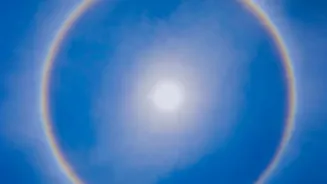
To see the whole show, you need to get high enough to see below your own horizon, where the rest of the water droplets are. This is why full-circle rainbows are most commonly seen from aircraft. When you're in a plane, flying above the clouds or rain, you have an unobstructed view. With the sun directly behind the plane, you can look down and see the aircraft's shadow cast on the clouds below, often perfectly framed in the centre of a complete, 360-degree rainbow. This rare and stunning sight, sometimes called a 'pilot's bow', can also be seen from very high mountains, bridges, or even by spraying a fine mist from a garden hose below you on a sunny day.