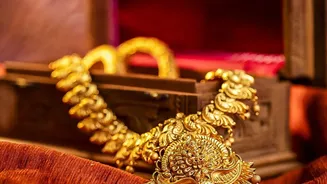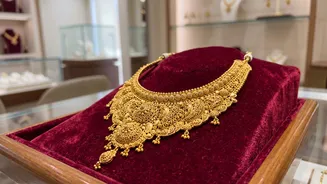







Dhanteras is here, and with it, the timeless tradition of buying gold. But as you step into a showroom, you may notice the price on the tag is much higher than the 'gold rate' on the news. Let's break down what you're actually paying for.
What 'Spot Price' and 'Price Correction' Mean
The price you
see flashing on news channels or financial websites is the 'spot price'. This is the market rate for pure, raw gold traded electronically on commodity exchanges like the MCX. It's essentially a wholesale price for bullion, not finished jewellery. Recently, you might have also heard talk of a 'price correction'. This term describes a temporary drop in gold prices after a period of sharp increase. A correction can be triggered by factors like rising interest rates or a stronger US dollar, which can make gold a less attractive investment for a short time. While a correction might seem like a great time to buy, the spot price is only the starting point of your final bill.
The First Hurdle: From Bullion to the Jeweller
Jewellers don't buy gold at the live spot price. They purchase it from importers and bullion suppliers who have already factored in several costs. The international gold price, set by benchmarks like the LBMA in US dollars, is first converted to Indian rupees. On top of this, import duties and other cess charges are added by the government. Finally, importers and banks add their own small margin before selling the physical gold bars or grains to jewellery retailers across the country. This landed cost, which is already higher than the screen price, becomes the jeweller's base rate for the day.
Making Charges: The Cost of Craftsmanship
The most significant addition to your bill is 'making charges'. This is the fee for the labour and skill required to transform raw gold into the beautiful piece of jewellery you want to buy. These charges cover everything from design and casting to soldering, polishing, and setting stones. Making charges are not standardised and can vary widely, typically ranging from 8% to over 25% of the gold's value. Intricate, handmade designs will have much higher making charges than simple, machine-made chains. Jewellers may quote this as a percentage of the gold value or as a flat rate per gram of gold.
The Tax Component: Understanding GST
The Goods and Services Tax (GST) is another key component of your final bill. In India, a 3% GST is levied on the value of the gold itself. However, the making charges also attract GST, often at a different rate. Some jewellers may apply a 5% GST specifically to the making charges, while others calculate 3% on the total value (gold plus making charges). This is why it's crucial to look at the itemised bill. It should show the gold value, making charges, and the GST applied to each component separately, ensuring transparency in the final cost.
Putting It All Together: A Sample Calculation
Let's see how this works with a simple example. Suppose you're buying a 10ndgram, 22ndkarat gold chain. The 24ndkarat spot price is ₹7,000 per gram, so the 22ndkarat rate (91.6% pure) is approximately ₹6,412 per gram.
Gold Value: 10 grams x ₹6,412/gram = ₹64,120
Making Charges: Let's assume 15% of the gold value. 0.15 x ₹64,120 = ₹9,618
GST on Gold: 3% of ₹64,120 = ₹1,923.60
GST on Making Charges: Assuming 5% on this component. 5% of ₹9,618 = ₹480.90
* Final Bill: ₹64,120 + ₹9,618 + ₹1,923.60 + ₹480.90 = ₹76,142.50
As you can see, the final price is significantly higher than the initial gold value. A small, mandatory hallmarking fee might also be added to this total.