



A Crucial Dress Rehearsal for Space
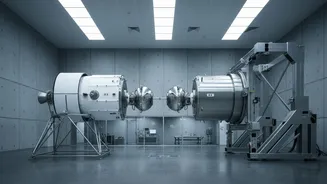
The Indian Space Research Organisation (ISRO) has developed a sophisticated Rendezvous and Docking (RVD) Simulator, a ground-breaking platform designed to test the intricate process of joining two spacecraft in orbit. Housed at the ISRO Telemetry, Tracking
and Command Network (ISTRAC) facility in Bengaluru, this simulator provides a high-fidelity, flight-like validation environment on Earth. It allows engineers to rigorously test the navigation, guidance, and control systems that are essential for any successful docking mission. Before sending billion-rupee assets to perform this high-stakes maneuver hundreds of kilometres above Earth, ISRO can now run countless scenarios, inject faults, and perfect its procedures in a controlled lab setting. This capability significantly de-risks future missions and accelerates the development timeline for some of India's most ambitious space projects.
What is Rendezvous and Docking?
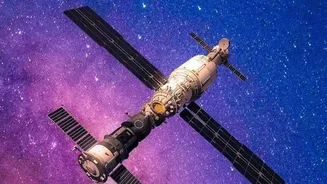
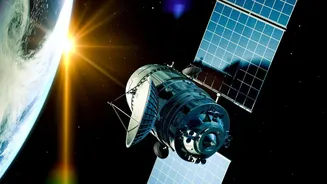
Imagine trying to link two cars together while they are both speeding down a highway at thousands of kilometres per hour. That, in essence, is the challenge of spacecraft rendezvous and docking. 'Rendezvous' is the process where one spacecraft, called the 'chaser', precisely adjusts its orbit to match that of another, the 'target'. This involves a series of complex orbital maneuvers to get into the same orbital plane and close proximity. 'Docking' is the final step: the physical connection of the two spacecraft. This requires incredible precision, as the chaser must approach the target at a very low relative speed and align its docking port perfectly before a secure connection can be established. Mastering this technology is not optional; it is fundamental for building modular space stations, conducting in-orbit servicing of satellites, and executing sample-return missions from the Moon or Mars.
Simulating a Zero-Gravity Dance
ISRO's RVD simulator is a 'hardware-in-the-loop' system, a clever setup that tricks real flight hardware into thinking it is in space. The actual flight computers, sensors, and navigation algorithms that will be used on the Gaganyaan crew module or future spacecraft are put through their paces. The simulator feeds these systems with computer-generated data that mimics what sensors—like cameras and lasers—would 'see' during an actual rendezvous in orbit. It calculates the complex orbital dynamics and simulates the response of thrusters, creating a virtual environment that is indistinguishable from the real thing from the hardware's perspective. This allows engineers to validate every line of code and every piece of hardware, ensuring they work together flawlessly to guide the spacecraft to a successful docking. It's a cost-effective way to achieve near-perfect operational readiness.
The Gateway to a 'Bharatiya Antariksha Station'
This simulator is more than just a piece of testing equipment; it is a cornerstone for India's future in space. The most immediate application is for the Gaganyaan human spaceflight programme. While initial missions will be simple orbital flights, future iterations will require docking with a space station for crew rotation or mission extension. The ultimate goal this technology enables is the Bharatiya Antariksha Station, India's planned sovereign space station. A space station is not launched in one piece; it is assembled module by module in orbit over several years. Each of these construction missions will rely on the exact rendezvous and docking technology being perfected today in Bengaluru. Without a reliable, indigenously developed docking capability, an Indian space station would remain a distant dream.
Building Self-Reliance in High-Tech Space
The development of the RVD simulator marks a major milestone in India’s quest for 'Atmanirbharta' (self-reliance) in critical space technologies. Rendezvous and docking systems are highly complex and strategically sensitive, and an in-house mastery of this domain places India in an elite club of space-faring nations. Currently, only the US, Russia, and China have proven autonomous docking capabilities. By developing this technology from the ground up, ISRO not only secures operational independence for its future missions but also builds valuable intellectual property. This opens up possibilities for future commercial services, such as satellite life extension or in-orbit repairs, and positions India as a more capable partner for international collaborative missions in deep space exploration.