







How can a rocket flight with an engine failure be considered a massive success? SpaceX’s 14th test of its giant Starship rocket did just that, reaching orbit for the first time and transforming a potential setback into a major leap forward.
A Fiery Ascent With a Twist
On September
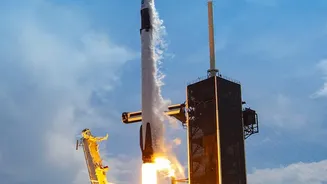
28, the world's most powerful rocket, Starship, thundered to life at SpaceX's Starbase facility in Texas. The 14th test flight aimed to push the vehicle beyond its previous limits, and for a few tense moments, it seemed the mission was in jeopardy. During the crucial climb to space, one of the upper stage's six Raptor engines shut down prematurely. On a live stream, mission controllers paused, assessing the new reality. Cheers erupted moments later when they gave the 'go' to proceed. The remaining engines burned slightly longer to compensate, pushing the spacecraft to achieve its primary goal: reaching Earth's orbit for the very first time.
Success Through 'Productive Failure'
An engine failure sounds like a significant problem, but for SpaceX, it's a valuable data point. The company's entire development philosophy is built on rapid, iterative testing, where anomalies are expected and learned from. This approach, often called 'failing forward', allows engineers to discover real-world limits faster than any simulation could predict. Despite the engine issue, Flight 14 successfully achieved its core objectives. It reached a stable orbit, and for the first time, deployed 26 operational Starlink satellites, proving its capability as a cargo hauler. The mission was shortened from a planned 10-hour flight to about three hours as a precaution, but the key milestones were met.
From Suborbital Hops to Orbital Leaps
This flight marks a monumental shift from Starship's previous tests. The first 13 integrated flights were all suborbital. They flew on high arcs, reaching the edge of space before falling back to Earth without achieving the velocity needed to circle the planet. Those earlier tests were crucial for proving concepts like stage separation and atmospheric re-entry. However, achieving orbit is a different challenge entirely. It requires reaching a speed of roughly 28,000 km/h. By successfully entering orbit, Starship graduated from a prototype in testing to a platform demonstrating operational capabilities. This was not just another hop; it was a leap into a new phase of the program.
What This Unlocks for SpaceX and NASA
A successful orbital flight, even an imperfect one, is the key that unlocks the future for Starship. It demonstrates to commercial customers and government partners that the rocket is on a clear path to reliability. This is particularly vital for NASA, which has selected Starship as the crewed lander for its Artemis program to return astronauts to the Moon. Before it can land humans on the lunar surface, Starship must prove it can operate reliably in orbit, eventually demonstrating capabilities like in-space refueling across multiple flights. Furthermore, the ability to deploy dozens of its own large, next-generation Starlink satellites in a single launch is a game-changer for SpaceX's business model, drastically increasing its network capacity.